On La Palma in December 2013
A visit to La Palma that was planned a little differently!
Originally, Micha and I were looking for a good spot to observe the "Comet of the Century," ISON.
This led to the idea of spending a week together on *La Isla Bonita* during the new moon in December 2013. Klaus Sachon, Dieter Martini, and the brothers Dieter and Wolfgang Jonda joined us.
The group had already proven itself on previous trips to China (2009), Carinthia (2010), and Australia (2012).
Even before our trip began—shortly after the comet reached perihelion—it became apparent that the spectacular morning sky show would not materialize. Unfortunately, Comet ISON was indeed completely disintegrated and vaporized as it rounded the Sun.
However, a substitute—the beautiful Comet Lovejoy—was also visible in the morning sky; more on that later.
On the morning of December 3rd, we gathered at Stuttgart Airport for our flight to Santa Cruz on La Palma.
We landed there shortly after 9 a.m. local time; 23-degree temperatures and sunshine made for a fantastic welcome.
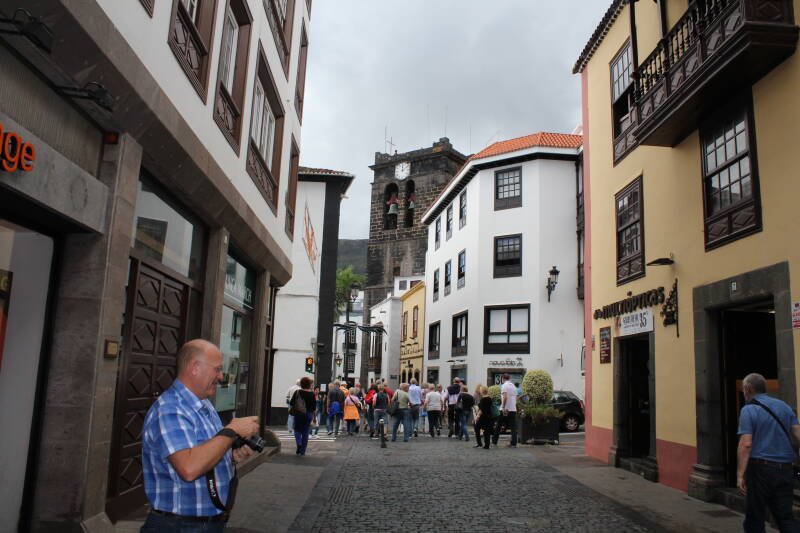
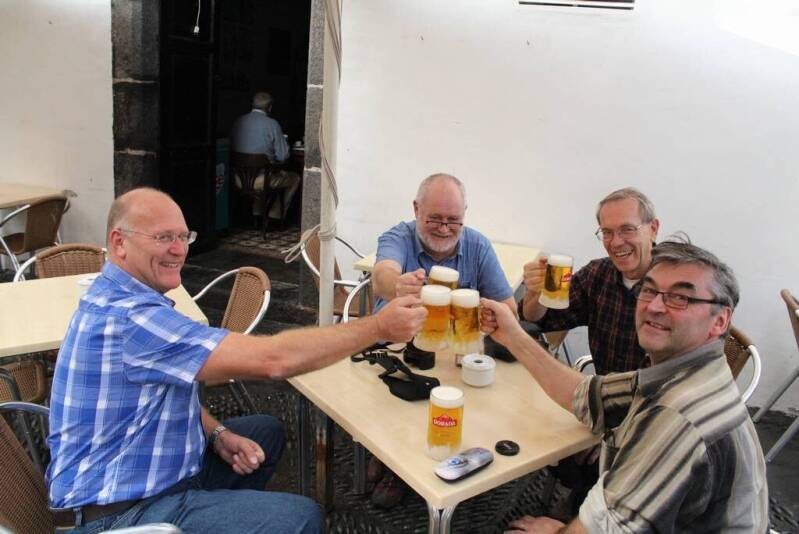
After picking up our rental cars, we headed into the center of Santa Cruz to see the local sights and enjoy a second breakfast of tapas and beer.
We spent the afternoon visiting the San Antonio volcano. Unfortunately, the path around the crater was closed due to local weather conditions (strong winds and fog).
Nevertheless, we were able to catch a glimpse into the impressive crater.
We drove in a convoy around the southern tip and on toward El Paso, then split up to pick up Dieter’s brother, Wolfgang, from the airport around 5 p.m.
Wolfgang’s flight from Munich arrived on schedule, allowing us to enjoy a leisurely drive through the Aridane Valley and up the winding road to the "Mirador El Time" viewpoint, which offered an atmospheric view of the west coast at dusk.
Shortly after nightfall, we arrived at our accommodation, "Mar y Monte," in Puntagorda.
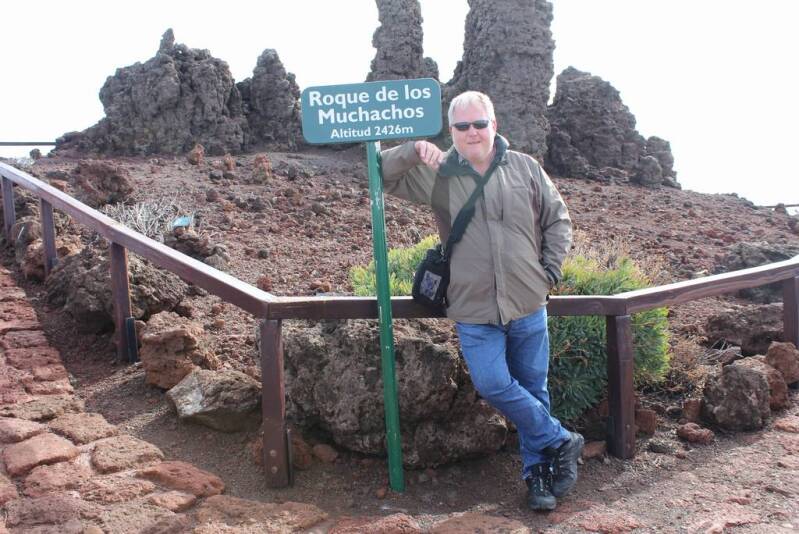
We celebrated our arrival and the start of our holiday together over paella and red wine at the local restaurant, "Jardín de los Naranjas." The next morning, following a fantastic breakfast—truly a special occasion orchestrated by our host, Axel—we set out to inspect the Roque de los Muchachos and scout for suitable observation spots.
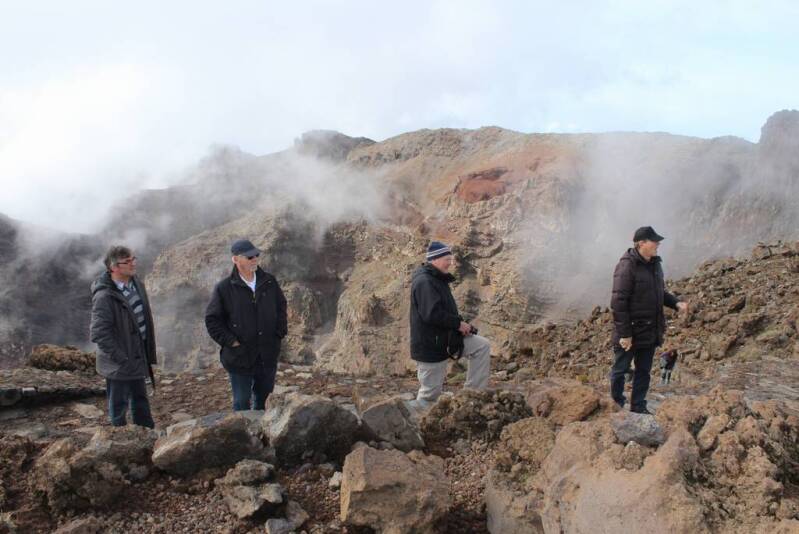
At the summit, clouds rising from the caldera swirled around us, severely limiting the view.
Am späten Nachmittag haben wir das Wetter um dem Roque von der Dachterrasse aus über unserer Unterkunft verfolgen können.
Around 6 p.m., we decided to load up the cars and drive back up to the Roque. We set up near the observatory under clear skies at 7 p.m., only to be quickly enveloped by rapidly rising clouds.
Conditions alternated minute by minute between partial clearing and being shrouded in dense fog.
Around 9 p.m., we packed up and headed back to Puntagorda.
We were greeted there by a starry sky; we set up our telescopes on the roof terrace and observed until around 2 a.m.
The following day, December 5th, we didn't head out until the afternoon for an excursion to the north, visiting the rocky islets of Roque de Santo Domingo and Roque de las Tabeidas.
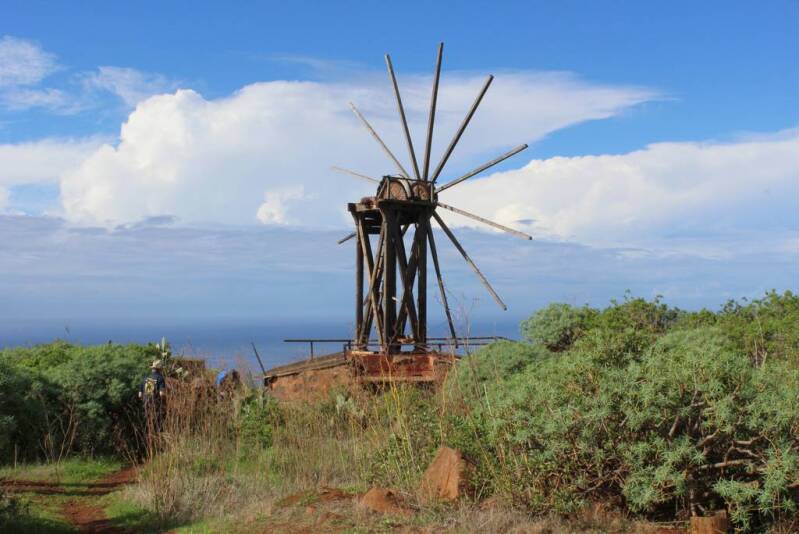
We inspected an abandoned windmill off the main road, looking at it from both the inside and the outside. Acting on a recommendation from our host, we enjoyed an excellent meal and drinks at the "El Bernegal" restaurant in Santo Domingo.
There were already several people waiting for a table when we arrived at the entrance.
We put our name down, returned a little later, and had better luck then. Unfortunately, the restaurant closed permanently on December 9th—a culinary loss for La Palma's north coast.
Under cloudy skies, we headed back to Puntagorda, where I went to bed early in the evening—around 9 p.m.
It was a good decision, as Wolfgang woke us up shortly after 2 a.m. An alert: the sky had cleared!
Within 30 minutes, the yellow 16-inch travel Dobsonian and a 120/600 comet-hunting telescope were set up on the roof terrace.
We were able to resume the observing program from the evening of December 4th.
Dieter Martini and I were the last observers left at 8 a.m.; the debris cloud from Comet ISON was supposed to be within the telescopes' field of view, but unfortunately, nothing of it was visible.
It was a public holiday on La Palma—St. Nicholas Day—and the skies had clouded over again.
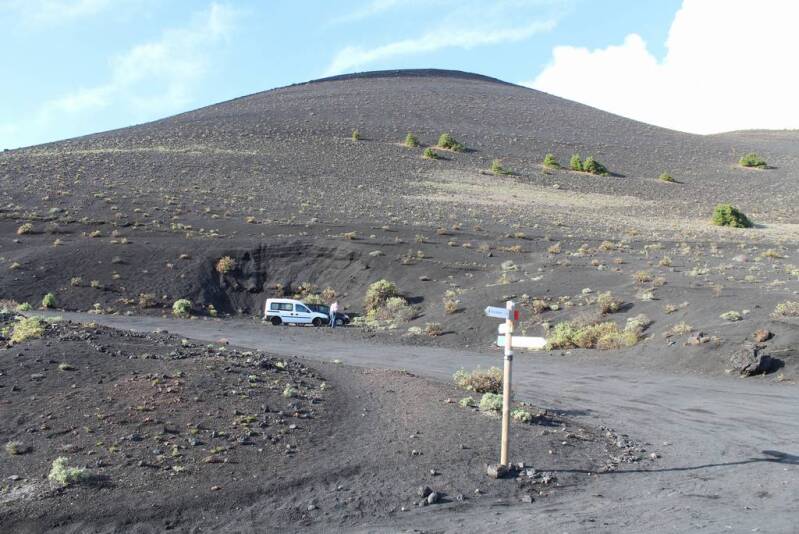
We set off for the south coast to visit the Teneguía volcano and explored the interior of the crater formed during the 1971 eruption.
Unfortunately, just as on our visit two years prior, we found no active, warm vents, though a lingering smell of sulfur remained.
A small cairn made of six stones—placed by six stargazers—was left behind on the crater rim for posterity.
Afterward, we visited the lighthouses and the salt pans at the southern tip of La Palma.
From there, the silhouettes of the neighboring islands of El Hierro and La Gomera were clearly visible.
The drive took us along the switchbacks of Las Indias—climbing a good 500 meters before descending to Puerto Naos—and from there, we made our way to the fishing village of El Remo.
We settled in at the middle restaurant and, less than 50 feet from the crashing surf, treated ourselves to grilled fish and *papas arrugadas* (wrinkled potatoes), accompanied by plenty of mojo sauce and aioli.
To keep the "fish swimming," we drank white wine from Teneguía, which we had visited earlier.
When we arrived in Puntagorda that evening, the sky cleared up.
We set up the telescopes on the roof terrace again at 10 p.m. and observed the stars until 2 a.m.
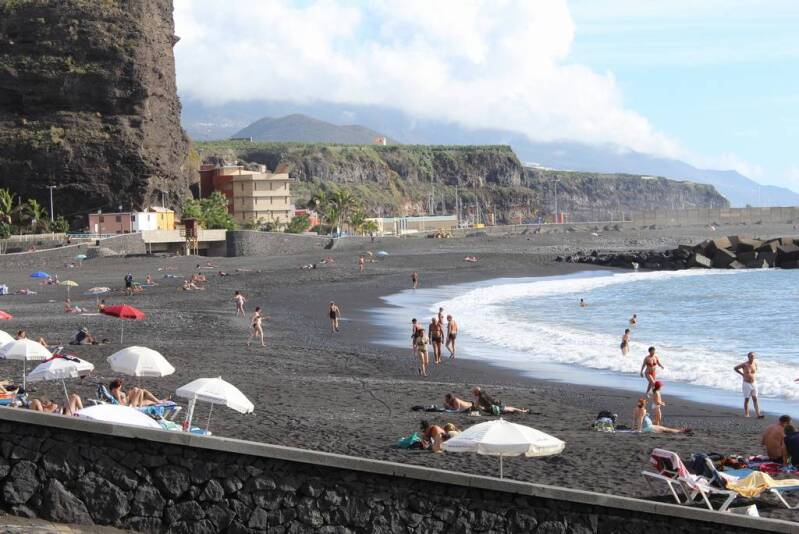
On Saturday, we explored Tazacorte Pueblo first, followed by Tazacorte Puerto; the beach was bustling with swimmers.
In the afternoon, we visited the impressive farmers' market in Puntagorda, which is open on Saturdays from 3 p.m. to 6 p.m.
There, we bought olives, cheese, ham, and fresh bread for a cozy evening in the garden cabin next to the guesthouse.
We defied the lackluster stargazing weather by having a thoroughly entertaining evening.
We got up early on Sunday morning, as we had a tour scheduled at the Roque for 9:30 a.m.
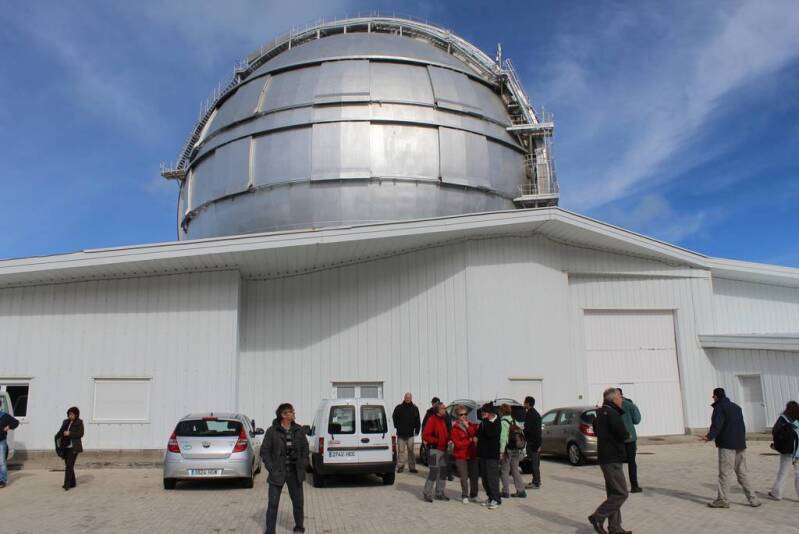
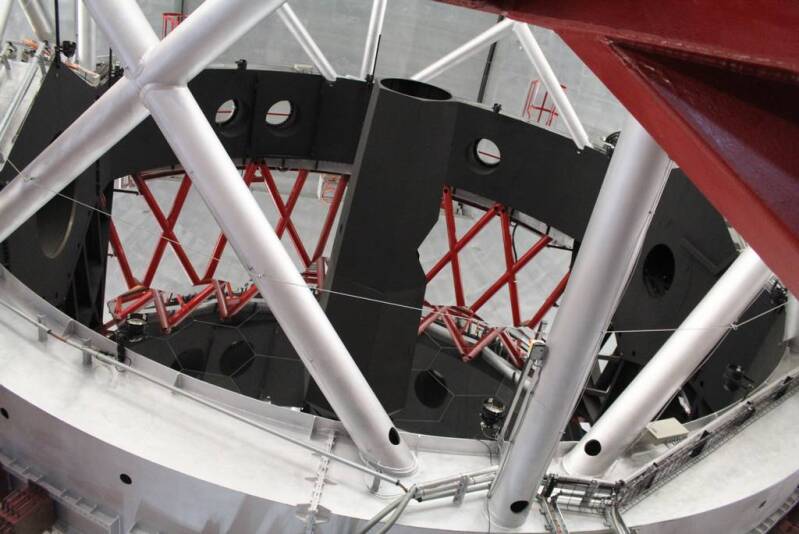
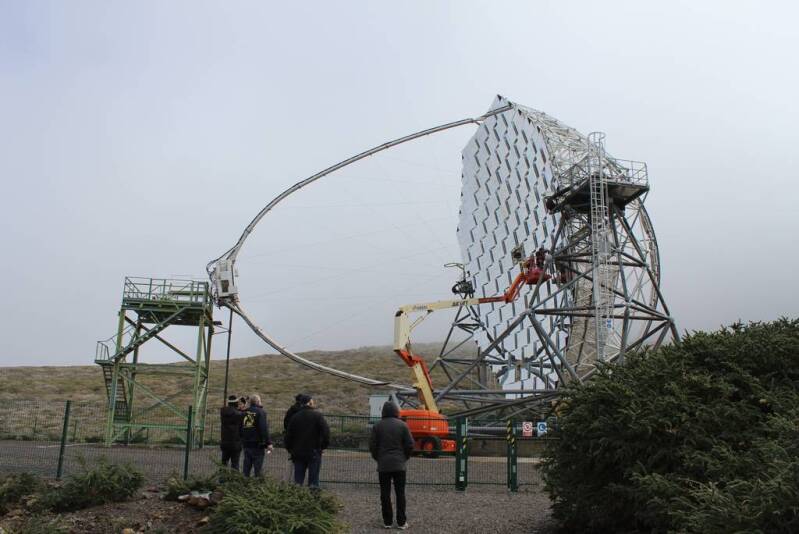
Led by an expert guide speaking both Spanish and English, we walked from the helipad—located in front of the two MAGIC telescopes—to the GTC dome; this time, we were able to admire the 10.4-meter telescope tilted all the way down toward the horizon.
After the tour, with weather conditions much better than on Wednesday, we visited the summit and the viewpoints, catching a glimpse of Mount Teide thanks to the excellent visibility.
Unfortunately, the sky clouded over again by evening, so we spent the rest of the night at the restaurant across from our guesthouse.
On the last day of our stay, December 9th, despite strong wind gusts, we registered at the visitor center in El Paso for a trip into the Caldera de Taburiente and obtained a permit to drive to the "La Cumbrecita" viewpoint.
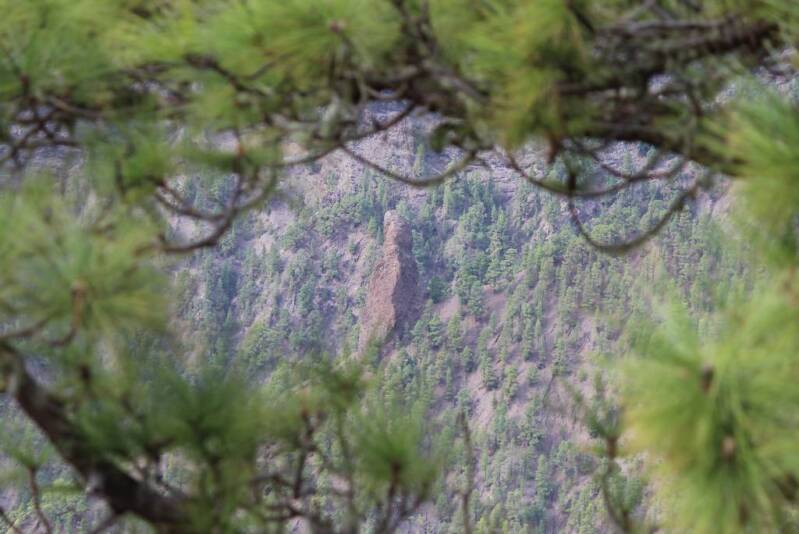
A walk in the lee of the caldera to a viewpoint further inside offered a view of the famous Idafe Rock. Afterwards, we drove up to the Mirador de los Jables viewpoint on the other side of El Paso, where strong winds nearly blew us away.
Afterwards, we drove up to the Mirrador de los Jables viewpoint on the other side of El Paso, where strong winds nearly blew us right off the spot.
Given the weather conditions, we decided to spend another evening in the garden cottage, stocking up on plenty of prawns and *papas arrugadas* at the supermarket in El Paso.
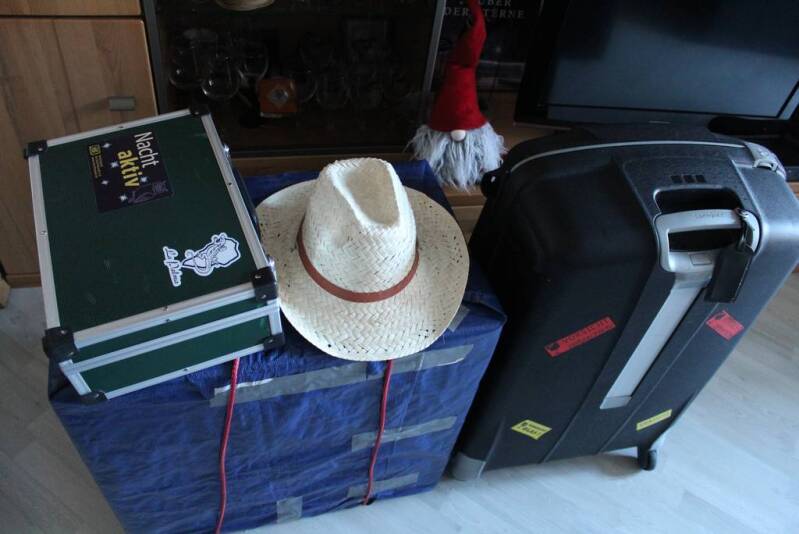
While I was packing the 16-inch telescope into its Styrofoam case early in the evening, Chef Klaus prepared a delicious dinner for us in the cottage kitchen.
It was a fitting conclusion to a stay on this beautiful island that—while different from what we had planned—was certainly memorable.
The next morning, we headed to the airport, full of anticipation.
All Binter Air island-hopping flights were cancelled due to strong winds.
Only the large aircraft were cleared for takeoff and landing in the crosswinds.
Our Airbus to Stuttgart landed safely at 9:30 a.m. We were cleared to take off an hour later.
La Palma Olé—I’ll be back!
The following day, air traffic across the Canary Islands was suspended, and the highest level of storm warning was issued.
A special thank you to Axel, the owner and host of the "Mar y Monte" guesthouse in Puntagorda, for the lovely morning refreshments and for keeping the premises—with their stylish and tasteful ambiance—so meticulously well-maintained.
I felt very much at home there.



Now for the observation report:
Summary of observations on La Palma in December 2013
I had been looking forward to nights of observing at Roque de los Muchachos with my 16-inch travel Dobsonian, under the best conditions the Northern Hemisphere has to offer.
A comet was also expected in the morning sky, promising a spectacular sight.
I set up the 16-inch telescope on the Roque on the evening of December 4th.
However, before I could get a good look at the first object, clouds rolled in quite rapidly.
Within a minute, the entire sky was overcast. We stood in the fog for nearly an hour before packing up.
Curiously, the sky cleared completely shortly thereafter, only to become three-quarters clouded over again less than five minutes later.
We decided to drive down the mountain—passing Michael Kunze, who, as we later learned, was stationed about two hairpin bends below the observatory grounds.
The sky was clear in Puntagorda, yet from our roof terrace, we could see clouds hovering over the Roque throughout the entire observing period.
Indeed, the clouds remained around the summit of the Roque until 6 a.m. on December 6th.
Southwesterly winds consistently filled the Caldera de Taburiente with clouds, which were then pushed over the rim of the Roque.
We began with the Orion Nebula; the seeing was exceptionally good on the evening of December 4th, allowing components E and F to stand out clearly alongside the Trapezium stars at 200x magnification using a 16-inch telescope and the new ES 9mm 100° eyepiece.
At this magnification and with the wide field of view, one can wander through the vast clouds of the nebula. The center appeared greenish, while the "wings" showed a delicate magenta hue; the blue coloration observed the previous year was not visible.
While Puntagorda offers a sky approaching magnitude 7, conditions up on the Roque are a cut above that again when the weather is good.
The planetary nebula NGC 1360—also known as the "Comet Planetary"—is very easy to locate in the constellation Fornax (the Chemical Furnace) due to its large, elongated shape. The distribution of brightness is somewhat uneven, with one side appearing brighter, and the central star is visible at the core.
At 200x magnification, the planetary nebula NGC 1535—known as Cleopatra's Eye—reveals two visible shells and a central star.
Sirius B flashed into view intermittently next to the diffraction spike at the 3 o'clock position; Dieter Martini was able to confirm the sighting—a challenging observation, in my estimation.
The Flame Nebula was easily visible at 60x magnification without a filter, and all the observers were delighted by the view.
I was also able to locate the Horsehead Nebula without a filter; less experienced observers appreciated the Astronomik UHC filter, while the Horsehead was even easier to spot using the Castell H-beta filter.
At 400x magnification (using a 4.7mm Meade UWA eyepiece), the dark structure that gives the reflection nebula NGC 1999 its name was clearly discernible.
The planetary nebula NGC 2022—also known as the "Collarbone Nebula" due to its location in Orion—appeared as a ring in the 16-inch telescope. Using a UHC filter, the slightly darker center was more clearly identified and observed at 200x magnification with a 9mm, 100° field-of-view eyepiece.
NGC 2346 is a small planetary nebula in Monoceros; its central star is very prominent, faintly surrounded by the shell of the nebular bubble, which is interrupted to the north.
The Rosette Nebula was easily visible without a filter; with a Baader OIII filter, the outer outline appeared larger, the nebula seemed more fragmented, and individual dark filaments were discernible within the nebulosity. Such a wealth of visible detail would keep a sketcher engrossed at the eyepiece for hours.
We slewed the 16-inch Dobsonian to NGC 2359 ("Thor's Helmet") and then observed M47 and M46, along with the planetary nebula NGC 2438.
We also didn't overlook the showpiece objects positioned near the zenith, such as Messier31 and Messier33. M33 was visible to the naked eye as a faint patch of light.
NGC 2903 appeared in the head of Leo quite early in the morning; we then slewed the Dobsonian to M95, M96, and M105 (along with NGC 3884), and on to the triplet of M65, M66, and NGC 3628. M51 also came into view towards morning; we then strolled over to M63 and M94, then to the Herring Galaxy (NGC 4631) with its companion, and finally to the Hockey Stick Galaxy (NGC 4646).
M13 was still too low, so we targeted M3, which was resolved right down to the core at 300x.
I aimed right between Denebola and Vindemiatrix and immediately spotted M84 and M86—along with NGC companions—within the nearly 1.5° field of view at 60x, using the 30mm Leitz 88° Astroplan eyepiece.
We then moved from "Copeland's Eyes" (NGC 4435/38) along Markarian's Chain—taking in NGC 4458, 4459, and 4461—over to M88.
I thoroughly enjoyed this journey across the sky, and my fellow observer Wolfgang was thrilled by the wealth of galactic detail visible along the way.
In the Big Dipper, I observed Messier81 and Messier82; afterwards, the greenish planetary nebula Messier97 and the slender galaxy Messier108 appeared together in the eyepiece without a filter.
In the constellation Corvus, I targeted the Antennae Galaxies (NGC 4038/39), which stood out clearly against the background. At 200x magnification, they looked like two earlobes stapled together.
Higher up, the cone of the zodiacal light shone clearly, extending all the way up to Leo.
Then, around 6 a.m., I aimed my 120/600 comet-hunting telescope over the roof terrace wall and—just above the western star in the Corona—spotted a bright Comet Lovejoy in the eyepiece, featuring a green coma and a tail about 3 degrees long.
A disruption structure was visible halfway along the length of the tail. In the 16-inch telescope, the coma appeared distinctly greener, but the overall impression in the comet seeker was more aesthetic.
Comet Linear was spotted with the 16-inch telescope, showing a magnitude of approximately 9.5, a slightly elongated coma, and the beginnings of a tail; the most detail was visible using the 18mm ES 82° eyepiece at 100x magnification.
We spent the time before the sky over the Roque summit became bright with daylight searching for remnants of Comet ISON—unfortunately without success.
Nevertheless, I was very pleased with the results of the observing session.
I saw two comets and Sirius B, as well as an incredibly detailed Jupiter—featuring the Great Red Spot, numerous bright and dark bands, a polar cap resembling a woolly hat, and a moon shadow—on December 4th at 300x magnification with a rock-steady image; that is not something you see every day.
Erstelle deine eigene Website mit Webador