Observation report, April 19, 2013, with a 30-inch telescope:
A night without airplanes.
A night featuring many galaxies and two comets—with no airplanes overhead due to the volcanic eruption in Iceland.
Observation from the dark plateau in the Swabian Forest on April 17, 2010, from 10:00 PM to 2:30 AM. Equipment: 30" f/4 Dobsonian; 31mm Nagler T6 (98x), 17mm Ethos (180x), 13mm Nagler T1 (235x), Meade UWA 8.8mm (350x); 200/1000 Newtonian finder scope with 35mm Panoptic (28x).
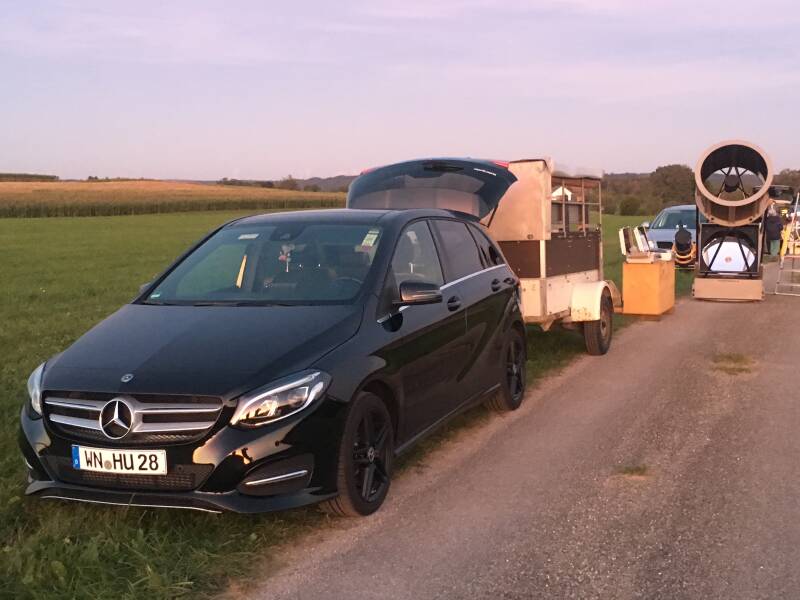
Arrived at the observing site at 9:20 PM, followed by setup. Fellow observers: Micha, Dennis, Markus, Mike, Monika, Don & Elena, Hannes, Ralf, Uli; Gerard joined later.
Additional telescopes and binoculars: 16" Dob, 14.5" Dob, 12.5" Dob, 10" Newtonian (astrophotography), 8" ARC, 6" Newtonian, Miyauchi 25x100, Meopta 12x60.
At the start of the session, I observed the 3-day-old Moon at 98x magnification using the 30" telescope. It was a beautiful sight, revealing countless details in superb resolution. Numerous details were also visible in the earthshine on the "dark side" of the Moon.
The open clusters in Auriga were observed but found rather underwhelming, as the Moon was still casting distracting light onto the primary mirror.
After 10:00 PM, and away from the setting crescent moon, M51 was targeted. The spiral arms were clearly visible, showing areas of increased density. Both arms featured nearly right-angled bends in their curvature; this was particularly pronounced in the arm facing away from the companion galaxy—specifically at the level of the companion—where a concentration of stars was visible within the bend. The companion galaxy did not appear round, but somewhat distorted. (Magnification: 98x, 180x, 235x)
Der Mond ist nun nicht mehr störend und M101 wird angefahren.
4 Spiralarme deutlich zu sehen, am Ende des linken 1 helle Aufhellung, am rechten 2 sehen,sind das HII Regionen? In den Spiralarmen werden nach einiger Zeit am Okular unzählige zarte Knoten sichtbar. (V=180x)
The next object is M109, a barred spiral galaxy viewed at an angle. The bar and spiral arms are clearly visible with averted vision; not far away—just over two fields of view, or about 1.5° to the south—lies the galaxy NGC 3953, where I have to use averted vision a bit more to make out the spiral arms.
NGC 4088 befindet sich etwa 5° SSO von NGC 3953,
Es ist eine GX in Kantenlage. Einen Staubstreifen kann ich nicht erkennen.
The next object is M106, a spiral galaxy viewed at an angle. Dust structure is visible near the core, and faint spiral arms with areas of higher density can be glimpsed using averted vision.
Nearby lie NGC 4220 to the north and NGC 4217 to the west; both are seen edge-on. Another, fainter galaxy is visible in the immediate vicinity of M106. I had to flip the Dobsonian twice for this object because it quickly reached the zenith limit. Observing at the zenith requires considerable physical effort, so I used a magnification of only 98x.
M94 displayed a very bright core and a ring-like brightening instead of spiral arms.
M63 appeared as an elliptical, extended galaxy; no other details were discernible.
NGC 4490 was seen with granular condensations, while the smaller, slightly fainter NGC 4485 showed no detail.
At 180x, NGC 4565 spans nearly half the field of view and displays a beautiful, sharply defined dust lane— a sight that delights the many fellow observers who gather in large numbers at the big Dobsonian to view this object.
In a 30-inch telescope, NGC 4725 is a textbook example of a barred spiral galaxy; two spiral arms wind away from the ends of the thick central bar in sharp curves. (Magnification: 180x)
"The Whale is blowing"—I find that a fitting description for NGC 4631; or, as Uli puts it, "the herring has spawned." The asymmetrical, narrow spindle appears very bright and distinct, featuring numerous clearly visible condensations and dust structures along its longitudinal axis. Above it, on the Whale's rounded hump, lies the small, round NGC 4627. (Magnification: 180x and 235x)
I now center the object M64; the dark, arc-shaped structure near the core is clearly visible, though the contrast reveals that the sky no longer offers the same transparency it did earlier in the evening. Once again, a large crowd has gathered around the 30 inch Dobsonian telescope.
At 1 a.m., Cygnus is positioned in the northeast; it is worth looking for Comet C/2009 K9 McNaught. I quickly spot it about 5° north of Deneb. Its elongated shape is clearly visible, and I can also make out a slight greenish tint. That makes this comet number 29 on my personal list.
Comet P81 Wild 2 in Virgo is at least two magnitudes fainter and about three times smaller in diameter. About ten days ago, it appeared significantly larger and brighter.
The Antennae Galaxies (NGC 4038/4039) are barely discernible against the horizon, which is brightened by atmospheric moisture. M104, the Sombrero Galaxy, once again drew the group together at the 30-inch telescope. However, the group agreed that the observing conditions were no longer particularly impressive.
A tour through the Virgo Cluster—taking in M100, M98, M99, M88, M91, M84/M86, M87, M89, and M90, as well as NGC 4438, 4402, 4435, 4461, 4473, 4477, 4459, 4298, and 4302—was somewhat disappointing due to the bright sky. Under good sky conditions, the objects observed could be seen with significantly smaller aperture.
At 2:30 a.m., I wrap up the night's observing session and slowly start packing up and dismantling the gear.
We load up Hannes’s equipment as well and head down the mountain. At 3:20 a.m., I arrive at the garage housing the 30-inch telescope in Backnang, just a minute after Micha.
I arrives at home around 4:40 a.m.
At 8:00 a.m. on Sunday morning, the alarm clock rings.
Cock-a-doodle-doo! ;-)
Erstelle deine eigene Website mit Webador