Observation report May 3, 2008, with the 30-inch telescope atop Hesselberg.
A large number of amateur astronomers—both new and long-time enthusiasts—as well as other interested individuals were invited by the "Backnanger Sterngucker" (Backnang Stargazers) to join a stargazing session on the evening of May 2, 2008.
The weather forecast had been monitored eagerly for several days beforehand.
When the forecast for the night of May 2–3 (from Meteoblue) remained unchanged during the first two days of May, it became clear that the evening’s destination would be a hilltop in the heart of southern Germany.
The two-hour drive took place under a predominantly overcast sky. Even after arriving around 8:15 PM, only a few breaks in the cloud cover were visible. After quickly setting up the Backnang Stargazers' 30-inch Dobsonian telescope, we stood—along with about 40 fellow observers and 10 other telescopes—beneath the clouds, waiting for them to clear.
By 10 p.m., it was briefly possible to target Messier101 and Messier51, but initially, only very small gaps in the cloud cover allowed a glimpse of the spirally arranged stellar fires.
Impatient observers initially compromised their dark adaptation at the 30-inch Dobsonian by observing the planet Saturn. Many moons could be counted.
Unfortunately, the moon Mimas was overwhelmed by the planet's bright glare. Since not every observer was familiar with manually tracking the Dobsonian telescope, the magnification had to be limited to 138x initially, and later to 234x.
Our patience was tested until shortly before 11 p.m., when large sections of the sky finally cleared. The Whirlpool Galaxy (Messier51)—once again the target of observation—drew a crowd to the ladder of the 30-inch Dobsonian. Everyone who had come up to the observing site lined up for a glimpse of the galaxy’s spiral arms, which appeared very bright and distinct—revealing numerous knots—within the field of view of the 20mm Nagler eyepiece (150x).
The next target—M13—favored by the vast majority at the observing site was centered in the view. At 217x magnification (14mm UWA), it was resolved right into the core and displayed ragged outer regions extending to the edge of the field of view.
Once again, an incoming bank of clouds initially put a stop to further stargazing. Shortly after midnight, the cloud cover finally cleared, though unfortunately, some astronomy enthusiasts had already headed home. With a reduced group—now numbering around 25 people—observations were able to resume.
NGC 4038 and 4039—the Antennae Galaxies—were located just west of the constellation Corvus. Unfortunately, haze on the horizon prevented the observation of details; the interesting pair of galaxies appeared only as faint outlines at 150x magnification using the 20mm Nagler eyepiece.
Using Paul's fine Miyauchi 20x100 binoculars, I attempted to locate the large galaxy M83, situated somewhat further south; I found a barely discernible, hazy patch—one that did not reward a follow-up observation with a larger-aperture telescope.
The beautiful edge-on galaxy NGC 4565 was a far more rewarding object; viewed with the 30" through Paul's 13mm Ethos eyepiece, it filled the 100° field of view and delighted observers with its dark, slightly textured dust lane.
An Iridium flare in the southwest with a magnitude of -7.7, announced by Horst, prompted many exclamations of delight—despite the need for dark adaptation.
M100 in the Virgo Cluster was the next object for the 30-inch Dobsonian. At 150x, beautiful spiral arms are visible.
The magnification was reduced to 100x to make it easier to sweep along Markarian's Chain of galaxies, from Messier84 and M86 up to M88 and M91.
Starting with M84 and M86, along with NGC 4387, 4388, and 4407, five galaxies appear together in the field of view of the 31mm Nagler eyepiece; several observers sweep the large Dobsonian back and forth along the chain, until finally—after a few false turns by various "Dob-pushers"—M87 comes into view.
The Sombrero Galaxy (M104) is quickly brought into view before it sinks too low into the haze of the southwestern horizon. A magnification of 150x clearly reveals its characteristic shape and a dark dust lane; unfortunately, observing conditions in this part of the sky are no longer optimal.
Moisture sets in around 3 a.m., and we turn to objects near Zenit that are more favorably positioned and more rewarding for our new fellow observers.
The Cirrus Nebula, already high in the east, is met with universal enthusiasm. The brighter section—featuring the "stag's antlers" (NGC 6992)—is particularly captivating, revealing fine structures in the light transmitted by the OIII filter.
Next, the Crescent Nebula (NGC 6888) appears in the field of view at 230x magnification, filling almost the entire frame. Fine, filamentary details within the nebula are visible.
The beautiful small planetary nebula NGC 6905 in the constellation Sagitta—also known as the "Blue Flash"—shines with a pale, blue-gray light. The central star flashes into view with averted vision; the southern edge appears broken, the eastern and western edges appear brighter, and dark structures are faintly visible in the northern half at 230x magnification.
The Dumbbell Nebula (Messier27), situated right next to it and thus impossible to miss, prompts our new fellow observers to remark once again: "Finally, something worthwhile to see."
Next, the "Embryo Nebula"—NGC 7008, located between Cygnus and Cepheus—is targeted using the Telrad finder. At 230x magnification, four stars are clearly visible: three forming the curve of the "ear" and one in the center—is that the central star?
In addition to using the Dobsonian telescope, the North America Nebula is located with the naked eye.
With M81 and M82 positioned high in the northwest, a successful night of observing draws to a close. M81 displays beautiful spiral arms.
M17 is best observed during twilight; the shape that gives the Omega Nebula its name becomes visible through a UHC filter. In smaller telescopes, however, it remains the Swan Nebula.
It was great fun, together with our old and new friends, to stand beneath the stars again after a long period of abstinence.
At 6 o'clock, the small group of survivors fortified themselves for the journey home in the bakery of the village neighboring the Gundelfingen heights, enjoying fresh coffee, buttered pretzels, and sweet pastries.
Throughout the two-hour drive home, Micha and I kept nodding in agreement that the outing had turned out to be a success after all.
Mike couldn't do that; he was busy driving us safely home.
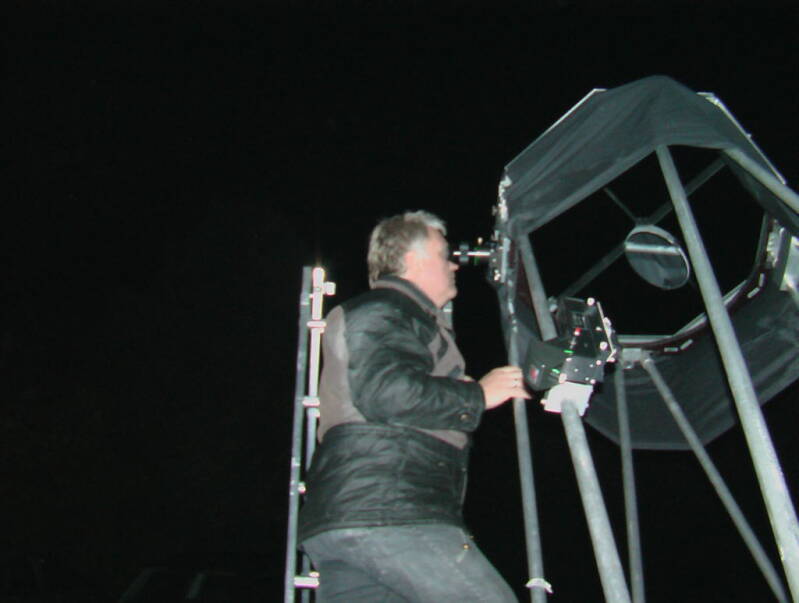
On the ladder at the 30-inch Dobsonian, observing at high declination.
Erstelle deine eigene Website mit Webador