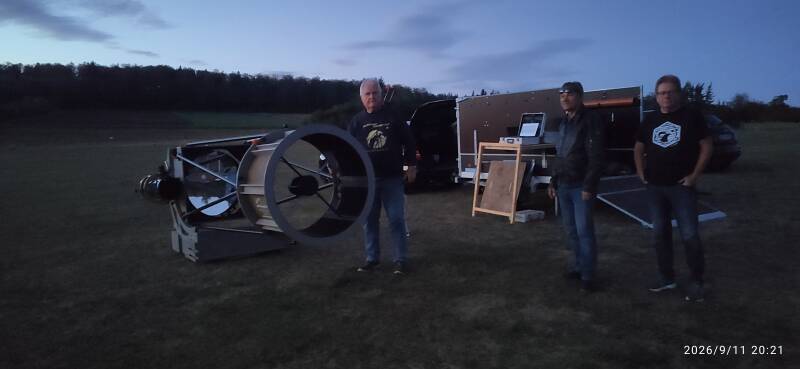
Preparing the 30Inch Dobsonian for observation on Münsingen airfield
With the 30-inch Dobsonian at the Münsingen/Eisberg airfield.
Stargazing Report: Supernova in NGC 7331 – September 11, 2026.
A stargazing session at the Münsingen airfield—hosted by Jürgen—had been in the plans for quite some time.
Finally, during the new moon in September, it was set to become a reality.
Before that, the question arose: Friday-into-Saturday or a day later? With three weather services providing five different forecasts, it wasn't an easy decision. In the end, we decided on Friday at very short notice—only at 2 p.m.
At 5 p.m., I set off for Backnang to pick up Michel, hitch up the trailer carrying the 30-inch Dobsonian, and then continue to Fellbach-Schmiden to pick up Jürgen. We arrived at the airfield at exactly 7:30 p.m. and set up the 30-inch Dobsonian on the tarmac.
Shortly afterwards, Andreas Bleil and Mario Nava joined us. Both had their imaging equipment with them—Andi an 8-inch Newtonian, and Mario an ED 120.
After dusk, Michel searched for the globular cluster Messier 22. At first, the smaller Messier28 appeared in the field of view near the tip of the "Teapot" asterism, though it was a lovely sight in its own right. Next, the Dobsonian was shifted slightly eastward; at 100x—the finding magnification with a 0.8° field—M22 appeared beautifully granular right into its core. The view was even better at 180x, while at 300x, the large, well-resolved globular cluster seemed to virtually explode outward.
Then I put the 31mm Nagler eyepiece back in and set out to find the Lagoon Nebula (Messier8) in the Milky Way. Locating objects with a field of view of only 0.8° on the large telescope—without using guide stars—is not easy when one lacks practice. That is why we used an 8-inch finder scope with a 2.5° field of view, which Michel used to guide us to M8. That process was quick and easy. The dark "lagoon" and the gas nebula—in which the star cluster is embedded—were visible with excellent contrast when using an OIII filter. At 180x magnification, the Hourglass Nebula—the brightest patch of nebulosity in the western section—stood out more clearly. Fellow observers were also shown the view both with and without a narrowband filter, using the filter slide.
After that, the Dob was nudged a bit further north to Messier20. The nebula's dark, three-part structure surrounding a star is clearly visible even without a filter, though it was more impressive with one.
Imaging of the Whirlpool Galaxy (M51) was quickly wrapped up before it sank too low in the sky. At 300x magnification, it fills the frame, and the spiral arms and the bridge to its companion are clearly visible. But not for long—a bright light suddenly shines right into the telescope!
So what is that!
Unfortunately, our stargazing was significantly hampered by the twin bright headlights of a farmer ploughing the field next to us on his tractor. A year ago—during our last stargazing session at the airfield on September 12, 2025—that same farmer had worked the very same field with his headlights on! Did that old fool get the day mixed up? "You're not due until tomorrow!" That’s how we used humor to make the annoying situation a bit more bearable.
It was 11 p.m. by the time the farmer and his tractor finally made their way to a field behind a patch of woods and were out of sight. After that, there was nothing but the sound of grinding machinery until midnight—when he finally knocked off for the day, much to our relief.
We continued on, sweeping the Dobsonian northward—surfing right through the Messier24 Milky Way star cloud ("Stars everywhere!")—and veering slightly right and left to take in Messier21 and Messier23 along the way. Combining our observational efforts (Michel on the 8" finder scope, myself on the Telrad), we zeroed in on the Omega Nebula, Messier17. With the OIII filter, the Omega shape appeared large and distinct—three times the size of the "Swan" and nearly filling the entire field of view. Fantastic! I called our two photographers over so we could admire this beautiful object together.
Next up was the Eagle Nebula (M16). The dark division between the wings was distinct; below this, as well as within one of the wings, the dark filaments known as the "Pillars of Creation" could be made out. One has to keep one's eye fixed on the view to discern these dark details, which are visible only in low contrast.
The Dumbbell Nebula (Messier27) was requested as the next target; Michel slewed the telescope to center it in the field of view. At 100x magnification without a filter, the nebula appeared greenish; adding a UHC filter boosted the contrast and revealed a shell-like structure surrounding the "dumbbell" shape. It looked absolutely spectacular at 180x.
The next object was NGC 6818, the Little Gem Nebula. It is a beautiful, round, greenish-blue planetary nebula located in eastern Sagittarius, near the border with Capricornus. Just below it lies NGC 6822—Barnard's Galaxy—which, unfortunately, I can only barely make out today using averted vision as a large, faint, oval glow.
Next target, the Saturn Nebula (NGC 7009) in Aquarius, was located and quickly found. It appeared as a bright, strikingly green oval at 100x; the green color persisted at 180x and 300x, where the tips could be seen using averted vision; at 480x (6.7mm eyepiece), it remained green, and the tips were visible with direct vision.
Der Helixnebel NGC 7293 wurde aufgesucht. Es hat ein klein wenig rühren am Himmel erfordert, dann war er mit Hilfe des OIII Filters mit 100x, unsere Aufsuchvergrößerung, deutlich sichtbar. Fast 1/3 Gesichtsfeld groß als dicker ovaler Ring zu sehen.
The galaxy M74 in Cetus—also known as Cetus A—was easy to locate. Its faint spiral arms, viewed face-on, were clearly visible at 100x magnification. Unfortunately, increasing the magnification to 180x did not yield the expected improvement; the object became too dim to reveal further detail in the spiral arms. After midnight, conditions turned damp quite suddenly, and I had to contend with fogging on my eyepieces and filters.
The primary and secondary mirrors of the 30-inch Dobsonian remained clear. Once the eyepiece had defogged, the Cirrus Nebula was once again a feast for the eyes. We scanned along the "Storm Bird" and "Deer Antler" (also known as the "Witch's Hand") and observed bright, filamentary nebular structures using an OIII filter. Finally, we slewed the Dobsonian to the somewhat fainter central section—Pickering's Triangular Wisp. The Cirrus Nebula is a showcase object for the 30-inch Dobsonian.
But our fellow observers also managed to pick up the two dust lanes below the core of the Andromeda Galaxy (M31). Compared to smaller optics, the 30-inch Dobsonian really makes you feel like you’re right in the middle of the object, rather than just looking at it from the outside. 😊
Then I slewed the Dob a bit further south to M33; at 100x, it beautifully reveals its spiral arms and the bright, nebulous patch NGC 604 at the end of one of them. Increasing the magnification brings out more detail, but the galaxy no longer fits entirely within the field of view. For me, the lovely overall view is lost as a result.
Moving on to the lower western end of the Pegasus Square, we come to NGC 7479, the "Butcher's Hook" galaxy. The bar was clearly visible; to make out the hooks, I inserted the 10mm Ethos eyepiece (yielding 300x magnification). An exit pupil of 2.5mm is often ideal for compact galaxies.
For me, the highlight of this night of observation was the supernova SN2026aaiv in the galaxy NGC 7331, located 45 million light-years away. At 100x—and even better at 180x—the supernova was the brightest object near the core.
Stephan's Quintet, located right next door, was barely discernible; the eyepieces had fogged up again. The star chart and the eyepiece case on the chart table were also soaking wet by now.
NGC 891, at the eastern end of the Andromeda chain, was quickly located after carefully wiping the eyepiece. At 180x, the dark dust lane was visible only with averted vision. At 300x, the image was too dark for my liking.
I targeted the small galaxy NGC 772 in Aries, though unfortunately, it appeared surprisingly faint. The sky was brightened by humidity, particularly to the northeast of Münsingen. I had previously managed to spot this galaxy under better conditions using an 8-inch aperture.
After an unsuccessful search for NGC 246—compounded by filters in the slide and the eyepiece fogging up again—we wrapped up our observing session shortly after 2 a.m.
At the very end, we did take a look at Saturn as a bonus, following repeated requests. At 300x magnification, it appeared sharp and steady in the field of view, well-positioned high in the sky. Unfortunately, there was some brightening around the planetary disk and reflections in the field of view caused by the eyepiece fogging up once more.
It took quite a while that night to pack up the accessories and load the Dobsonian into the trailer. We had warned our fellow photographers beforehand about the dim lights we were using while packing up, so they covered their optics.
We set off for home with the trailer at 2:45 a.m. After a smooth drive, Jürgen was able to get out in Schmiden at 4:00 a.m. By the time the trailer was back in the garage in Backnang, Michel had been dropped off there, and I had arrived back home in Korb, it was 5:00 a.m.
I had set off exactly 12 hours earlier. My goodness, how time flies!
Erstelle deine eigene Website mit Webador