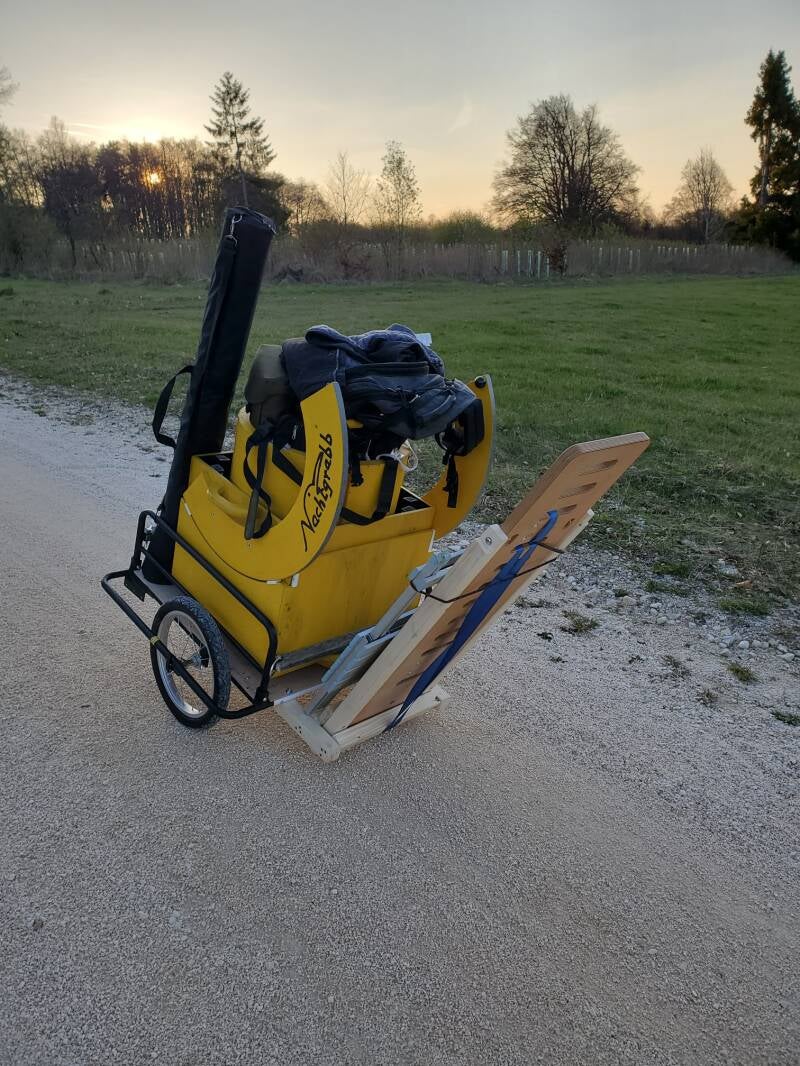
Rolling into dark corners with the "Nachtgrabb" on the wagon.
The first excursion into a dark spot within the former Münsingen military training area.
I set off for Römerstein-Zainingen at 6 p.m. It was a leisurely drive out of the Remstal valley, across the Schurwald hills via Plochingen and Kirchheim unter Teck, into the Lenninger Tal, and then up the Grabenstätter Steige ascent onto the Swabian Alb.
I arrived at the stargazing spot near Römerstein-Zainingen around 7:15 p.m.
Micha was already there; within a few minutes, we had unloaded, assembled the transport cart, and loaded up the "Nachtgrabb" along with its accessories.
That was where the walking path began—past the barrier and into the former Münsingen military training area in the Swabian Alb.
This location was the original inspiration for building the second housing for my 16-inch Dobsonian—the "Nachtgrabb"—complete with a cart that serves me well at other sites, too.
After some exertion—pushing the fully loaded transport cart, weighing a good 50 kilograms, up two inclines along gravel paths—we arrived at the observing site.
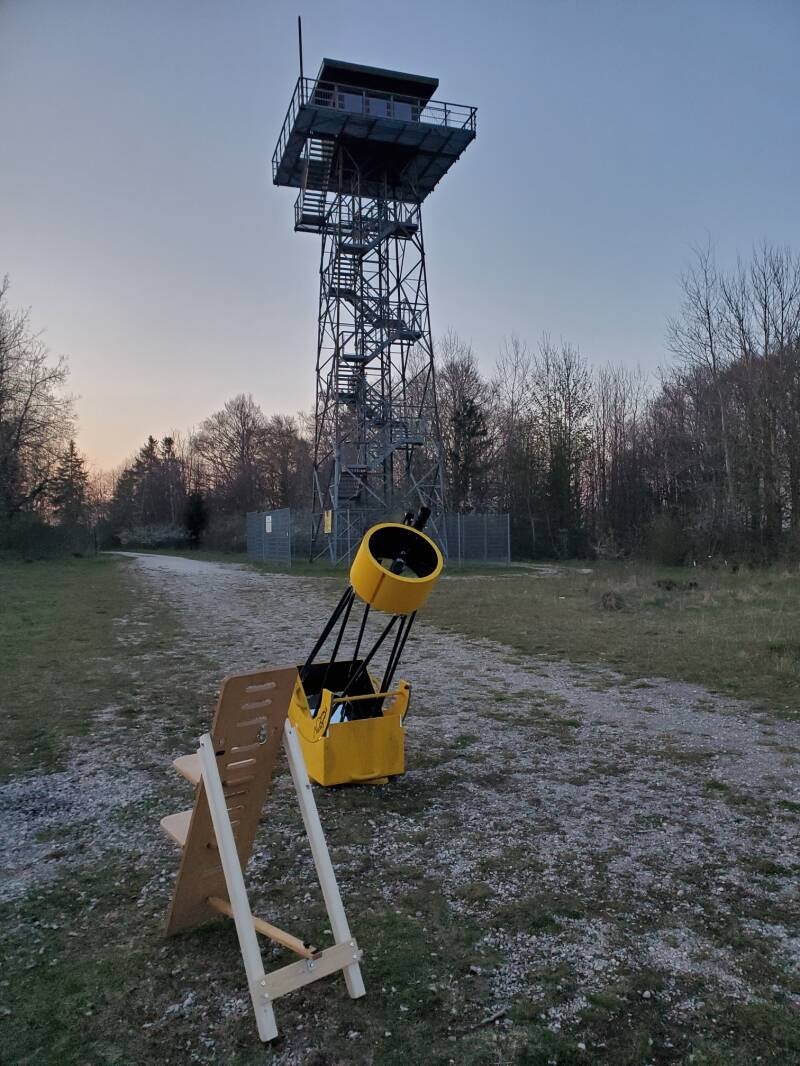
It was a trek of just under a mile into the former training grounds, heading toward the Waldgreut Tower.
By 8:00 p.m., the telescope was set up and aligned.
As darkness fell at 9:00 p.m. I climbed the Waldgreut tower to look for Mercury.
I spotted it low in the northwest using binoculars, about 3° below the Pleiades.
Afterward, I made my way slowly and carefully back down the tower to join Micha.
I couldn't help thinking that if you took a tumble down those somewhat treacherous open-grid metal stairs in the fading light, you’d just end up lying right where you fell.
After twilight ended around 10 p.m., I swept the area of the constellations Ursa Major and Canes Venatici with my Dobsonian telescope.
My first stop was the galaxy Messier51; even at a low search magnification of 60x—using a 30mm Leitz eyepiece—it revealed its spiral arms. At 200x (using a 9mm 100° ES eyepiece), I quickly and roughly—or "quick and dirty," as the modern phrase goes—sketched what I saw while sitting on my observing chair.
The sketch isn't meant to be a work of art—I’m certainly not capable of that—but rather a way to capture what I observed.
Messier101 was the next object; I attempted to sketch it as well, though I haven't yet managed to capture this beautiful galaxy in a way worth showing. However, it did help to better compare the details I observed in the spiral arms with Micha.
The beautiful galaxy Messier106, located a bit further on, revealed hints of its spiral structure; it was somewhat more difficult to track at 200x magnification because, at that moment, it was positioned directly at the zenith.
Messier94 appeared significantly more compact, with a bright core; no further details were visible around the bright center at 200x magnification.
The situation was quite different with the beautiful, large galaxy NGC 4631, the Herring Nebula. At 200x, it revealed its lovely, off-center shape, along with a foreground star and a round companion. I once again attempted to capture this at the eyepiece using pencil and paper.
I also sketched the shape of the nearby galaxy NGC 4656-7, known as "the Hockey Stick."
The "Black Eye" of galaxy Messier64 was the next target. At 200x magnification, a crescent-shaped dark structure could be seen in the eyepiece near the core.
The Needle Galaxy (NGC 4565)—located next to the beautiful star cluster Mel 111—was the next object to be centered in the field of view; it was sketched using paper and pencil at approximately 130x magnification (using a 14mm 100° ES eyepiece).
Next up was the Coma Cluster. By positioning the Telrad finder exactly between Denebola and Vindemiatrix, the "face" is quickly located. It is formed by the arrangement of the galaxies M84, M86, and NGC 4388, with the small NGC 4387 serving as the nose.
Using the finder eyepiece at 60x, we counted a total of seven galaxies in the field of view. I slewed the Dobsonian along the chain of galaxies to "Copeland's Eyes" and then on to the galaxy M88. We used 60x for the overview and 130x for a bit more detail. Micha and I took turns scanning the area, taking our time and enjoying the view.
Afterwards, we turned our attention to M87 and attempted to spot its jet at magnifications of 320x and 520x—unfortunately without success.
We then moved to Messier99 on the other side of the Virgo Cluster. At 200x, the galaxy revealed its beautiful spiral structure; however, discerning details within the arms proved very difficult for two slightly older observers with somewhat diminished eyesight.
That would be a task better suited to our next-largest instrument, the 30-inch f/4 Dobsonian.
With all the activity in this part of the sky, I didn't get around to using paper and pencil; besides, that would have become a bit too tedious for my fellow observer, Micha.
Messier104, located in the southern part of the constellation Virgo, was the next target. It is one of my favorite objects—one that captivated me thirty years ago when I was using my old 17.5-inch Coulter mirror. A magnification of 200x provided a pleasant, comfortable view, allowing me to enjoy the dark edge of the uniformly shaped spindle while sitting back in my observing chair.
The planetary nebula NGC 4361 in the constellation Corvus was quickly located using the Telrad. At 200x magnification, a faint disk surrounding a bright central star is visible. Using an OIII filter made the disk stand out more clearly but did not reveal any additional detail.
We then turned our attention to the constellation Leo, which was sinking towards the horizon. First, we sought out NGC 2903—already low in the sky—where the bar structure was easily discernible at 200x.
A sweep to the triplet concluded our tour of the night sky. At 130x magnification, all three fill the field of view, and the bottom one—"the Hamburger"—faintly reveals a dust lane along its midline.
The former military training area is a wonderful spot in the region to enjoy the starry sky in peace and quiet, surrounded by nature—and with eyes adapted to the dark.
Thanks to the restricted access, it will remain that way. Cyclists and pedestrians are permitted to use the designated paths.
This now includes a small cart carrying a yellow 16-inch Dobsonian telescope named "Nachtgrabb."
Shortly after 2 a.m., we were back at the car—transport cart and *Nachtgrabb* in tow—outside the military training area, ready to load up.
After a leisurely drive, we arrived home safely at 3:30 a.m.
During the drive, I spotted the first clouds gathering in the northwest.
We did everything right. :-))



Erstelle deine eigene Website mit Webador