Observing report with new 30-inch, Emberger Alm, Oct. 2007
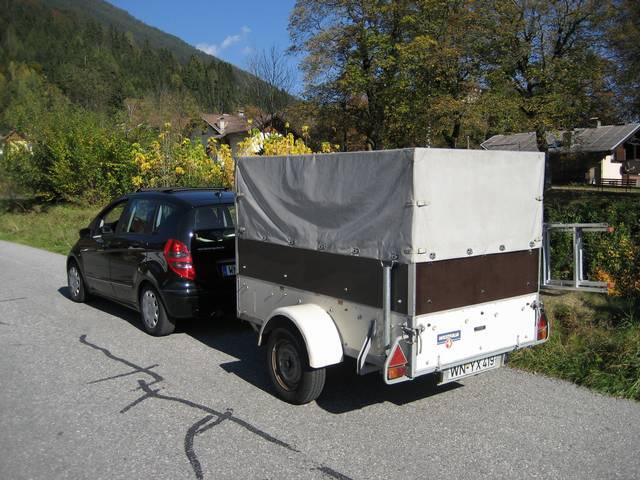
The combination: Mercedes A180d and the 30-inch Dobsonian in the trailer.

Setup on the upper meadow above the Emberger Alm inn.
Dear friends of the starry sky, here is the report on our stay in Carinthia with the new 30-inch f/4 Dobsonian: A week of stargazing at the Emberger Alm during the new moon period from October 8 to 13, 2007 (Monday to Saturday)—the week following the ITT telescope gathering.
We departed from Backnang at 5:30 a.m. on October 8, 2007, and arrived at the Emberger Alm at 3:20 p.m. We set up the 30-inch telescope on the western meadow above the inns; Roland Herrmann joined us with his 24-inch f/4.2 telescope.
Before dinner on the day of our arrival, we glue the rougher Ebonystar variant onto the altitude bearings to make the telescope’s altitude movement smoother. With a tube weight of 300 pounds, existing rules of thumb for this procedure don't apply. Roland helps us trim the glued-on Ebonystar strips to the required width, so the task is completed in about an hour, despite our improvised tools.
At 8 p.m., we gather on the field for observing. I can only describe my personal impressions using the 6"f/5 Jaegers refractor as a rich-field telescope, Roland’s 24"f/4.2 lightweight Dobsonian, and our own 30"f/4—the new build by the Backnang Stargazers.
The following report is a compilation of observations from three nights: October 8th (until 3:00 a.m.), October 11th (until dawn the following day), and Friday, October 12th (until midnight).
Objects viewed through the 6"f/5 Jaegers refractor: Messier11, seen alongside the Scutum Star Cloud within the field of view. M11 shines brightly—with a prominent central star—right at the edge of the star cloud. I also find Messier16 and Messier17 together in a single field of view below it.
In the 30-inch telescope, Messier17 lives up to the name "Omega Nebula," while in the 6-inch, it retains the appearance of the "Swan Nebula." The dark lanes within M16 (the Eagle Nebula) are visible in the 30-inch even without a filter, and are unmistakable with a UHC filter.
Unfortunately, the Milky Way objects slightly further south have already set behind the mountain ridge where the ski lift is located.
Over the course of the night, the North America, Pelican, Crescent, and Cirrus Nebulae (viewed as a continuous complex), the Helix Nebula, and the California Nebula—as well as NGC 253 and 288 within a single field of view—are observed using the 6-inch Jaegers telescope
We center Uranus in Roland’s 24-inch Dobsonian, and the moons Titania (mag. 14.0) and Oberon (mag. 14.2) are visible stacked vertically just to the left of the 12 o'clock position. Naturally, we have to confirm this observation using the 30-inch telescope.
Messier51 is a must-see object just before it sets behind the Naßfeldriegel mountain ; it displays its spiral arms in a somewhat more compact form compared to the nearby Messier101. In M101, the arms appear larger and more loosely structured, though, in return, beautiful knots are visible.
In the direction of Draco, Messier102 (NGC 5866) appears as a bright spindle in the 30-inch telescope at 235x magnification. About 1.5° away, NGC 5907 reveals itself at 235x as a beautiful, slender edge-on galaxy with a clearly visible dust lane.
NGC 6503 is the next object; this spindle, with a magnitude of 10.2, is easily located with the 30-inch.
Other observers are eager to view NGC 6543. At 100x magnification, it shines as a luminous green ellipse with a bright central star. The central star serves as an excellent reference point for achieving sharp focus. Seeing conditions limit us to 350x magnification, which reveals nested shells; however, the dark structures around the central star that we observed in 2003 remain hidden from us this year.
We swing the mirrors westward in good time, before Hercules sinks too low.
The magnitude 15 galaxy IC 4617—located near M13—is found at the tip of a diamond-shaped star pattern, halfway between M13 and the magnitude 11.6 galaxy NGC 6207.
The performance of both instruments is compared using the globular clusters M13 and NGC 6229. Initially, the 24-inch holds a slight advantage; however, after performing a star-based collimation on the new 30-inch, the latter manages to edge out the competition by a narrow margin. Roland’s 24-inch scores points thanks to the quality of its mirror. Consequently, for many objects, the difference is smaller than previously anticipated. Where raw photon count is the deciding factor, the 30-inch holds the advantage.
The galaxy group centered on NGC 6166 (Abell 2199) is targeted. It is located approximately 2 degrees northwest of M13. The galaxy NGC 6166 appears as the largest object in the field, with other smaller galaxies visible in its vicinity.
The next object is the planetary nebula NGC 6408 in Aquila. At 235x magnification, I see a 35" disk with a central star; a star located at the edge has the same brightness.
NGC 6781, also in Aquila, is much larger at 100" but remains a faint disk even when the magnification is increased to 350x. Poor seeing prevents higher magnification.
In the small planetary nebula NGC 6891 in Delphinus, the central star shines brightly out of the 14" disk.
NGC 6894 is known as the Ring Nebula in Cygnus. At 235x magnification, it resembles the Ring Nebula in Lyra when viewed through a 6-inch telescope.
The planetary nebula NGC 6905 in Cygnus, known as the "Blue Flash," indeed displays a more bluish hue than its counterparts, which tend to shine with a greenish light. At 235x magnification, two dark structures on the nebula's disk can be faintly discerned alongside the central star.
By comparison, the Dumbbell Nebula is a dazzling object. At 350x magnification, in addition to the central star, we can see a striking diamond-shaped arrangement of four stars within the disk. The "ears" are unmistakable, regardless of the filter used. Roland spots a segment of the outer shell that I would have otherwise overlooked.
The Ring Nebula (Messier57) reveals its central star somewhat more clearly in Roland’s 24-inch telescope, whereas the galaxy IC 1296 is easier to locate in the 30-inch.
Next, we impress the visitors standing nearby on the western meadow with a view of the Cirrus Nebula through the 30-inch telescope. At 100x magnification with an OIII filter, brilliantly bright details are visible in the eastern section. The members of the queue behind the focuser need patience while each observer takes their turn panning across Pickering's Triangular Wisp and the Witch's Broom.
The wait can be passed by viewing the Cirrus Nebula in its entirety through a 6-inch Jaegers telescope, offering a 3.2° field of view at 25x magnification with a UHC filter.
IC 1318—the Butterfly Nebula near Gamma Cygni—followed by a pan to the Crescent Nebula (NGC 6888), then back up to the North America Nebula, and slightly below it the distinct Pelican Nebula (IC 5067) , delighted the observers at the 6 inch Jaegers.
The Cocoon Nebula (IC 5146) is unmistakably identifiable at the end of the dark nebula B 168 when viewed through a 30-inch telescope without a filter. The UHC filter makes the object stand out from its surroundings, while the H-beta filter reveals beautiful details.
NGC 7008 in Cygnus is the next object for both Dobsonian telescopes. Resembling a severed earlobe pierced by stars, this beautiful object is located at 100x magnification. At 235x, more detail becomes visible; the response is weaker with a UHC filter but strong with an OIII filter.
The Blinking Planetary (NGC 6826) ceased its "blinking" effect when viewed through apertures of 24 and 30 inches.
In a 30-inch telescope at 235x magnification, the planetary nebula PK93-2.1 in Cygnus appears as an egg-shaped object measuring 30 arcseconds across; it responds well to a UHC filter.
In Lynx, we observe the large, faint planetary nebula JN1 (PK 164+31.1). At 100x magnification with an OIII filter, the 30-inch Dobsonian reveals a large, faint ring containing two areas of brightening visible via averted vision—the "Galactic Headphones."
The Bubble Nebula (NGC 7635), located just under 1° from M52, reveals two nebulosity-shrouded stars at finder magnification; one of them shows structure. At 235x magnification with a UHC filter, the bright edge of the bubble appears somewhat brighter and more distinct in the 30-inch telescope than in Roland's 24-inch Dobsonian.
In the constellation Lynx, we target the galaxy NGC 2537 (the Bear Paw Galaxy). At 350x magnification, the structure that gives the galaxy its name is visible using averted vision. A little to the south, we find IC 2233—a very thin spindle shape that appears in the same field of view as NGC 2537 at 100x magnification (also using averted vision). At 350x magnification, a faint star is visible in the southern extension of this narrow streak, with a double star located right next to it.
Roland shows me the Egg Nebula in Cygnus (CRL 2688) through his 24-inch telescope; at 370x magnification, it appears as a very small object. Higher magnification is not feasible given the current seeing conditions.
For a change of pace, a completely different object is the IC 1396 nebula complex—spanning 2.5 by 2 degrees—located below Cepheus. The ideal telescope for this is once again the Jaegers 6-inch f/5 refractor.
At the same time, the large telescopes are aimed at the open star cluster NGC 6939 and the beautiful spiral galaxy NGC 6946—located 1° to the southwest—situated below Cepheus. At 235x magnification, the spiral galaxy is visible face-on, spanning approximately one-quarter of the field of view. The spiral arms are easily visible in the 30-inch and 24-inch telescopes.
The beautiful Iris Nebula (NGC 7023) is the next target for the 30-inch telescope. At 100x magnification, the reflection nebula is visible—featuring lovely dark structures surrounding a star—though unfortunately, the blue color is not apparent.
On the other side of Cepheus, we turn our attention to NGC 40. At 350x magnification, dark structures appear around the central star within the slightly oval nebular bubble, dividing the bubble like slices of pizza.
The Pacman Nebula (NGC 281) in Cassiopeia is the next object on our list. Viewed through a 30-inch telescope with a UHC filter, the object fills almost the entire field of view. The edges of the "maw" appear ragged, and several dark structures are visible within the nebular mass.
The next sweep moves to Perseus and NGC 1275, the central galaxy of the Perseus Cluster (Abell 426). About a dozen galaxies are visible along an arc crossing the field of view at 235x magnification.
Below Alpha Pegasi lies the beautiful galaxy NGC 7479, known as the "Butcher's Hook." At 250x magnification in Roland's 24-inch telescope, the structure that gives the object its name is visible.
Roughly halfway between Beta Persei and Alpha Andromedae—slightly above the direct line connecting them—we locate the planetary nebula Jones 1 (PK104-29.1) using the 30-inch telescope and a UHC filter. At 100x magnification, it resembles a greenish *Vanillekipferl* (a crescent-shaped Christmas cookie popular in southern Germany)—specifically, a 270° arc that fills about a quarter of the field of view at 235x.
A sweep to the northwest brings NGC 7331 into view. With an aperture of this size, Stephan's Quintet is a must-see target, as are the faint companions surrounding NGC 7331—namely NGC 7335 and NGC 7340. Within the Quintet, NGC 7318 could be resolved into two separate cores at 235x magnification.
NGC 7814 is located on the opposite side in Pegasus, within the quadrilateral near Gamma. At 370x magnification in Roland’s 24-inch telescope, it appears as an edge-on galaxy with a razor-sharp dust lane.
The group centered on NGC 90 (Arp 65) is observed using a 30-inch telescope. This group can be found along the line connecting Alpha Andromedae and Gamma Pegasi—positioned about 40% of the way from Gamma—and then 2° in the direction of Pisces. At 235x magnification, six galaxies are visible in a T-shaped arrangement, with magnitudes ranging from 12.5 to 15.
The group centered on NGC 70 (Arp 113) is located 2.5° east of Alpha Andromedae; comprising NGC 67, 68, 70, and 71—along with NGC 72, situated slightly apart—this collection is described by some observers as a group of faint, fuzzy objects.
The group centered on NGC 383 (Arp 331) is located 2.5° southwest of Beta Andromedae. Viewed through a 30-inch telescope at 235x magnification, a line of seven galaxies is visible.
Moving 2° further west, we encounter the group centered on NGC 507; viewed through a 30-inch telescope at 150x magnification (using a 20mm Nagler T2 eyepiece), it fills the entire field of view. Within this field—spanning approximately 0.5°—nine galaxies can be seen arranged in an arc. The brightest object is NGC 507 (also known as Arp 229), with a magnitude of 11.2.
For a change of pace, we slew the telescope to M33. At 100x magnification, the galaxy fills the field of view, revealing structural details within the spiral arms that delight visitors from the lower observing area.
Just next to Beta Andromedae, NGC 404 stands out clearly beside the bright star when viewed through a 30-inch telescope at 100x magnification.
M31—with its three partially structured dark lanes—ruins one's dark adaptation, causing the eye to crave brighter objects.
We target NGC 246 in the constellation Cetus. Viewed through a 30-inch telescope at 235x magnification, this planetary nebula responds differently to UHC and OIII filters.
Not far away, we locate the Seyfert galaxy M77. At 235x magnification, we see an oval galaxy with a very bright core.
M74 in Pisces is a beautiful face-on spiral galaxy; using the 30-inch telescope, we can easily discern its spiral arms even at the 100x search magnification.
Despite its low altitude and the resulting atmospheric haze, NGC 253 in Sculptor is a magnificent sight; at 150x magnification in the 30-inch telescope, it no longer fits entirely within the field of view. Countless dark patches are visible within the dust lane.
In the 6-inch f/5 Jaegers telescope, the galaxy and the globular cluster NGC 288 appear together in the same field of view. A sweep into Perseus reveals NGC 1499—the California Nebula—when using an H-beta filter with the 6-inch Jaegers; a band approximately 1° wide fills the 3.2° field of view.
A little further north, the Helix Nebula (NGC 7293) delights us in the 30-inch telescope as another object that fills the entire field of view.
After a late-night snack break, it was worth seeking out the emission nebula NGC 1999—also known as the Keyhole Nebula—in Orion. It was easy to locate at 100x magnification, and the dark structure was beautifully visible at 350x.
Below Orion, in the constellation Lepus, we target the small planetary nebula IC 418. At 100x magnification, a delicate ring clearly stands out around the very bright central star. At 350x magnification, radial structures within the nebular shell can be glimpsed.
Thor’s Helmet (NGC 2359) is the next object centered in the 30-inch telescope. Using an OIII filter at 150x magnification, both "wings" of the helmet are beautifully visible.
Covering an area roughly three fields of view in diameter at 100x magnification is required to explore the Rosette Nebula. Within the nebula's ring, numerous dark bubbles and filamentary structures are visible using UHC and OIII filters.
Located further north, NGC 2261—Hubble's Variable Nebula—appears as a striking triangular object at 100x magnification in a 30-inch telescope.
Unfortunately, we could not see the faint Cone Nebula in the Christmas Tree Cluster, located about a degree to the north.
Roland shows us the Medusa Nebula in his 24-inch Abell 21 (PK 205+14.1). At 100x magnification and using a UHC filter, a filled crescent shape spanning approximately a quarter of a degree is visible.
The Horsehead Nebula (B33) is the next object viewed with the 30-inch telescope. At 100x magnification and using an H-beta filter, it is easily visible in this instrument. However, the structure of the horse's snout was more clearly defined during the 2003 ITT. Thanks to our filter slide, we can compare visibility using a UHC filter versus no filter. Even with the UHC filter, a dark indentation in the curtain of IC434 can be made out—a feature that can also be glimpsed with a 6-inch Jaegers telescope and an H-beta filter, provided one knows the object's exact position and orientation.
At M78, the receptors in the eyes can recover somewhat. At 100x magnification, the shape and dark structures are clearly visible.
The galaxy NGC 2403, located in the faint constellation Camelopardalis, is our next object. Through Roland’s 24-inch telescope at 250x magnification, we can see two spiral arms with knots in a face-on view.
The galaxy NGC 2841, located in the upper paw of Ursa Major, appears as a beautiful spindle at a 100x search magnification; about 5° away lies NGC 3079, a fine example of an edge-on galaxy.
The onset of dawn—with the zodiacal light visible as far as the Beehive Cluster (Praesepe) in Cancer—signals the end of the night.
M81 and M82, along with their companions NGC 3077 and NGC 2976, bring a beautiful night of observing under the new moon at Emberger Alm to a close. Through a 30-inch telescope at 100x magnification, two beautiful spiral arms are visible in M81.
Our new build successfully achieved "first light," and we made new friends.
Representing the Backnang Stargazers were: Daniela, Jörgen, Erich, Dennis, Micha, and Gerd.

Morgens in der Dämmerung grüsste die Venus vom Himmel. Aufnahme von Dennis Hasenstein
Erstelle deine eigene Website mit Webador