A 16" Dobsonian for travel by plane—the "Zitronenfalter" (Lemmon Butterfly)
Highly motivated by my field trip to the island of Lastovo in the summer of 2010, I wanted a reflecting telescope that was as large as possible for me yet suitable for air travel. Reports on Timm Klose’s 16-inch and 18-inch travel-friendly instruments showed me some great possibilities. However, I didn’t want to copy them exactly; I also wanted to incorporate many of my own ideas.
I noted the following in the project specifications: a 16-inch primary mirror of the highest possible quality, with a focal length matched to my height. Roland Herrmann more than fulfilled this wish with a superb 16-inch f/4.5 mirror that is just 25 mm thick. To complement it, I acquired a premium 3 inch secondary mirror from Antares
I found a stable JMI focuser through a fellow stargazer classified ad on the Astronomie.de forum.
All told, the cost ended up matching the sale price of the Zeiss telescope, but I was unwilling to compromise on the quality of the optical and mechanical components.
Additional key specifications: Minimal packed size and a truss tube assembly with detachable poles. Comfortable viewing thanks to good stability. As lightweight as possible, yet steady. Materials: wood and aluminum. Incorporate plenty of personal ideas into the design and construction!
The basic idea for my design came to me while looking at the dartboard in my workshop. I recalled a dartboard cabinet with hinged doors that I had once seen in a pub. A similar type of box was to become the housing for the mirror cell; the doors would serve as swing-out side panels, while insertable boards would form the top and bottom of the mirror box.
A frame featuring an integrated baffle and a protective cover is attached to this assembly. Clamping blocks for the truss poles are mounted at the corners of the frame. Two side brackets made of plywood—featuring supports for the altitude bearings—hold the collapsible primary mirror box together and provide structural stability. Started screws secure halved bicycle rims, which serve as the altitude bearings.
Strips of Ebony Star laminate have been bonded to them to serve as the bearing surface. The rim's drop center ensures lateral guidance for the altitude bearings. The corresponding Teflon pads on the rocker box were contoured to match the shape of the rims.
I adopted the idea of using bicycle rims for the altitude bearings from a forum post on Astrotreff regarding Sudan Jackson's 16-inch "Bicycle-Rim Dobsonian."
A foldable, air-travel-friendly telescope finished in a distinctive yellow glaze inevitably gave rise to its name: "Zitronenfalter" (Lemon Butterfly)!
Aluminum furniture knobs from IKEA , a Swedish Furniture store ,serve as the ball heads for clamping the rods to the top assembly. The top assembly is clamped using four bicycle quick-release skewers to aluminum angle brackets that feature drilled recesses acting as ball sockets.
The lightweight JMI eyepiece focuser is mounted on a small board that slides in from below via a dovetail guide; for transport, this board is stored in the eyepiece case.
A small upward-facing arm serves as a mounting platform for the Telrad finder. The secondary mirror is bonded to a lightweight cell featuring integrated adjustment mechanisms. For transport, the cell and secondary mirror are stored in a twist-lock container within the eyepiece case. Inside the compact rocker box, the upper assembly and the baffle frame are placed first, followed by the "dartboard cabinet" unit, which sits flush with the top edge of the rocker box.
For air travel, this package is packed in a Styrodur box. That’s a trick I learned from Timm Klose. :-)) The mirror rests in a custom-made case made of birch plywood. This is transported inside a hard-shell suitcase, cushioned by clothing, alongside the disassembled pole assembly.
The telescope weighs 50 pounds; it is not the lightest model—a compromise made in favor of stability and viewing comfort. For air travel, my hard-shell suitcase—containing clothing, the mirror, and the truss poles—weighs 70 pounds The Styrofoam box, which also held small items of clothing, weighed 35 pounds. My carry-on luggage consists of a small case containing the focuser, the secondary mirror, and four eyepieces.
The observations made with the 16-inch on the canary island La Palma are described on the "Travels to Dark-Sky Sites" page.
.

The aluminum ball heads are accessories for IKEA furniture.

All components and the housing for the primary mirror at a glance.
The tripod bag contains sectional poles.
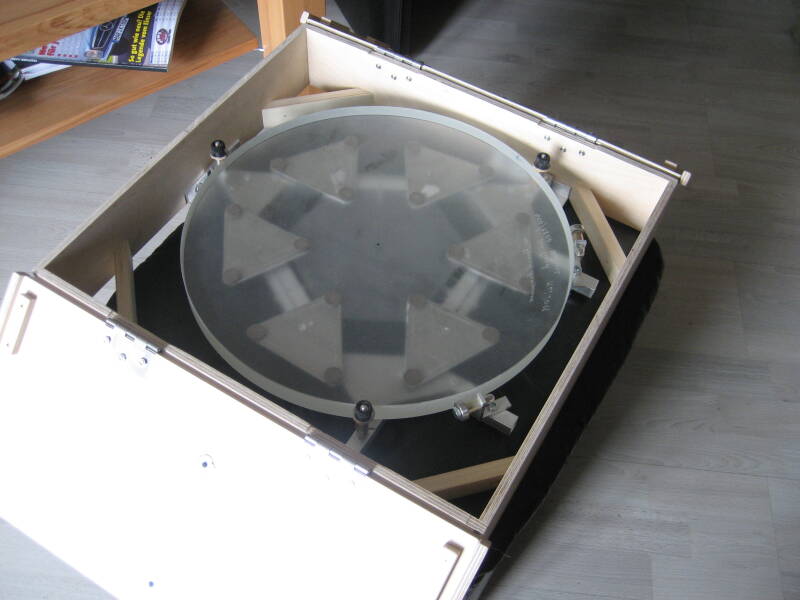
The small dartboard cabinet with a compartment and a naked mirror blank
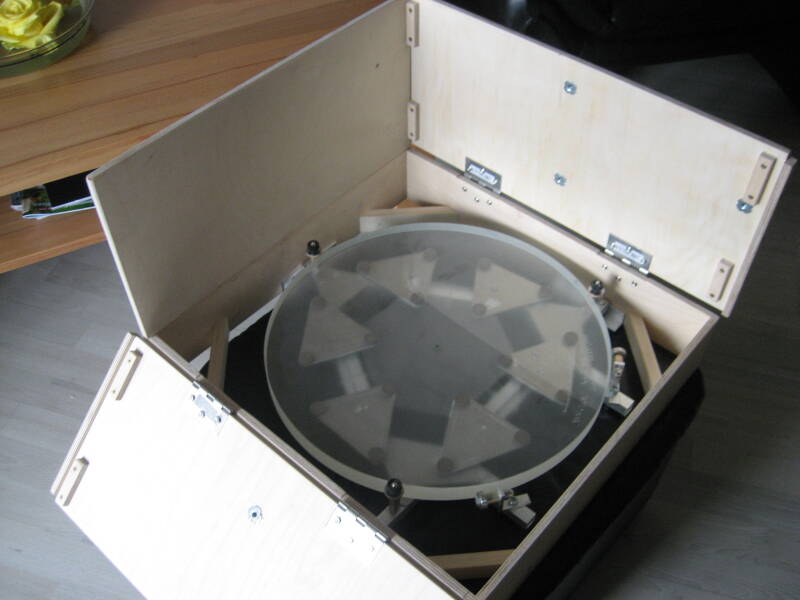
With the doors raised and two insert panels, it turns into a box.
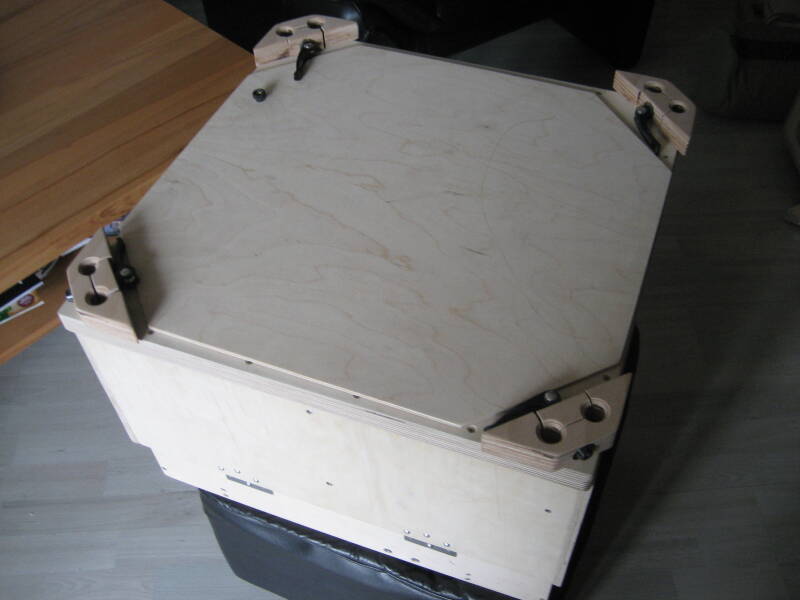
A frame featuring guide grooves for the side walls and clamping blocks for the grid tubes is fitted onto the assembly.

The frame is clamped to the box on both sides by these components.
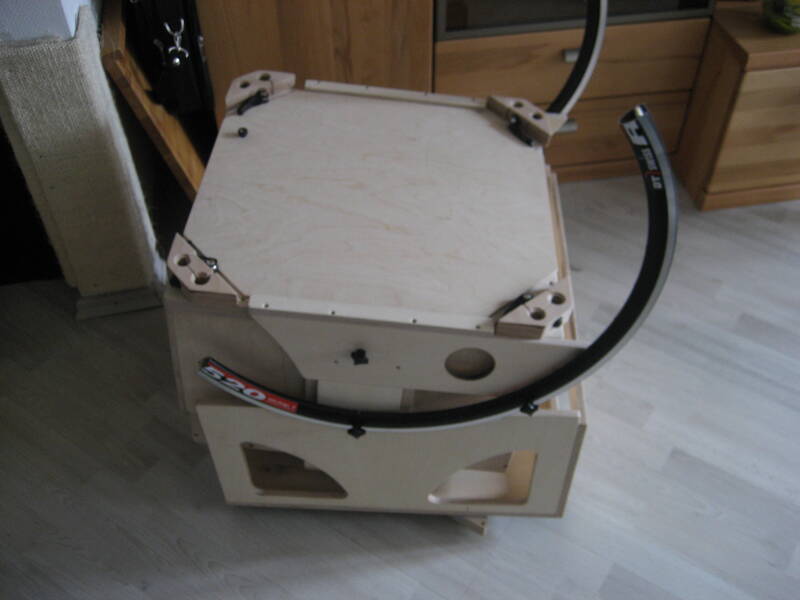
These clamps serve as bearing surfaces for the altitude wheels.

The basis for the rocker box's azimuth bearing.
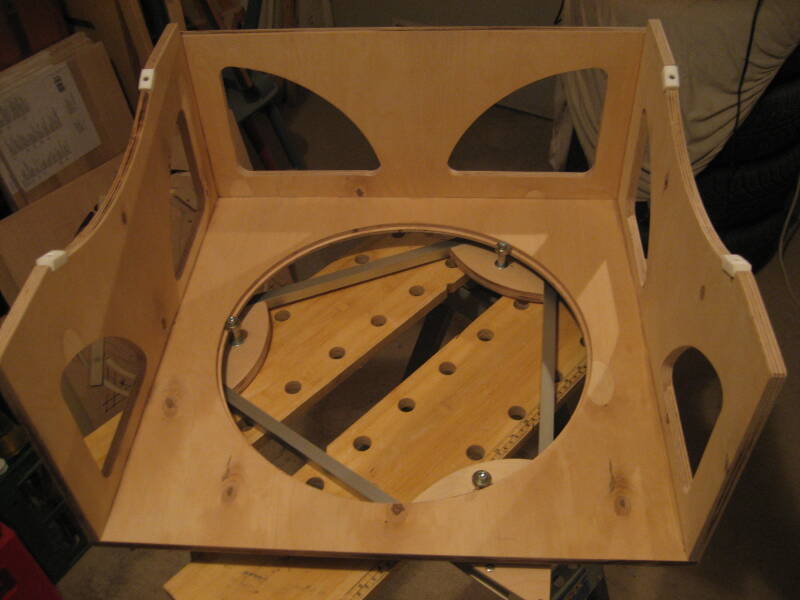
The rocker box is mounted on the base so that it can rotate.

Thanks to the collapsible elements, the tube fits flush into the rocker box when retracted.

Initial assembly of the completed telescope.
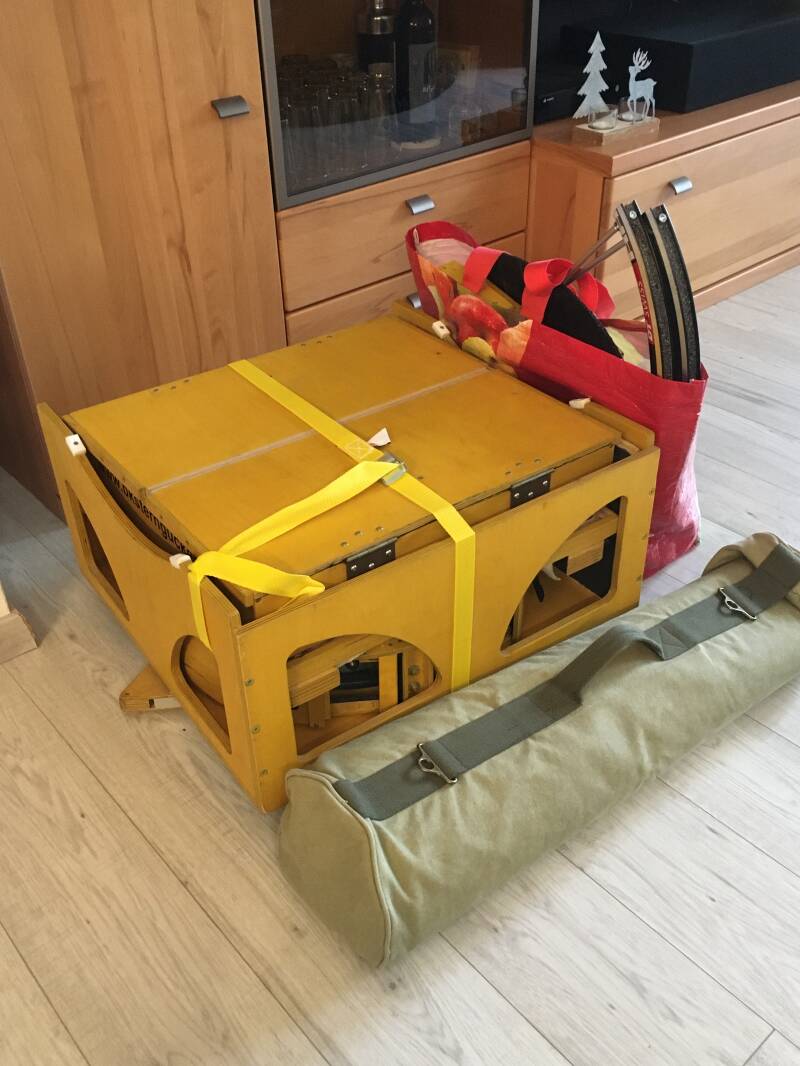
The packed travel Dobsonian, including the pole bag and the hard case for both the mirror box and the altitude bearings.

On the Roque des los muchachos, within sight of the Mercator Telescope (Belgium, 1.2m)
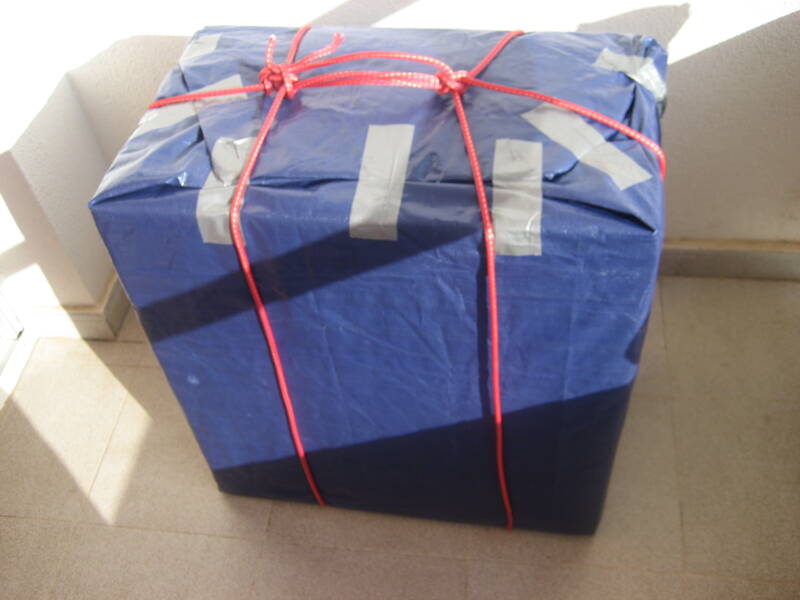
Für die Flugreise kommt der Dobson in eine passgenaue Styrodurbox die am Flughafen als Sperrgepäck aufgegeben wird.
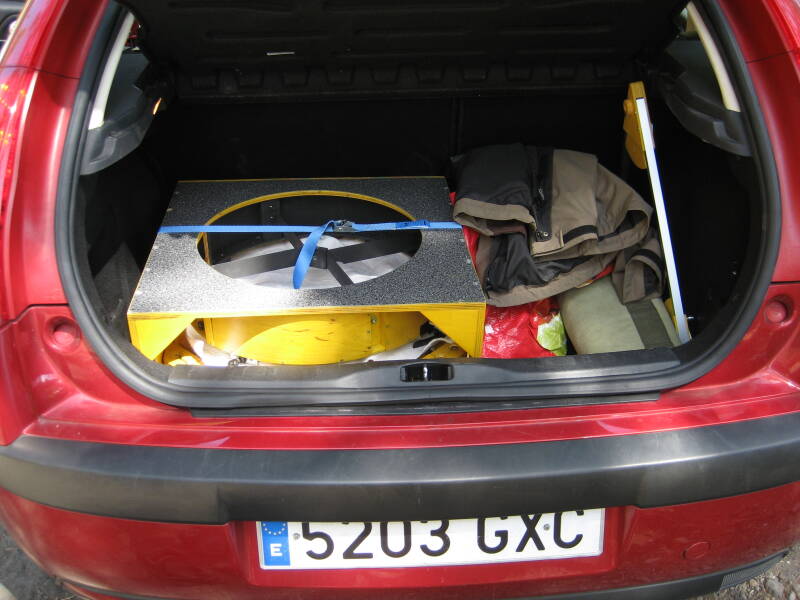
The 16-inch travel Dobsonian in the trunk of the rental car on La Palma island

Before the guided tour for a Hamburg school class at El Paso, la Palma island
Erstelle deine eigene Website mit Webador