Observation report from September 18, 2007, with the 6" f/5 Jaegers refractor.
The steel-blue afternoon sky inspired me to rally my stargazing buddies for a night of observing. At 8:45 PM, the two of us rumbled up the winding road to Bürg in Mike’s "Ford Galaxy." From there, we saw a blood-red crescent moon resting on the horizon behind the town of Winnenden. Anticipation for great conditions began to build!
After driving another 20 minutes into the Swabian outback, we arrived at a high plateau in the Swabian Forest—far removed from streetlights and their intrusive stray light. You need at least two ranges of hills in between to escape the light pollution from Stuttgart and the Rems Valley!
My nice "stroll-and-gaze" telescope—an old Jaegers 6" f/5 refractor—was quickly set up.
While Mike was still assembling his beautiful 12.6" f/6 Dobsonian, I already had Messier7 in my field of view, framed by the treetops. The "Butterfly Cluster" is one of the southernmost objects that can be glimpsed from the Swabian Forest.
The constellation Sagittarius offered up a succession of globular clusters for viewing: Messier69, Messier70, Messier54, NGC 6624, NGC 6522, and M28, as well as the beautiful Messier22. M22 is already resolved at 25x magnification in a 6-inch telescope. A 3.3° field of view allows for a easy star hopping among these objects.
Messier55 is located somewhat apart, further to the east. Its stars are too faint to be resolved individually in a 6-inch telescope; it appears as a cotton-ball-like patch about 1/4° in size, with no central concentration. Mike’s 12.5-inch telescope resolves this globular cluster into individual stars.
As I turn towards the center of the Milky Way, I come across Messier8 and Messier20. Both are visible within the field of view of my Jaeger telescope at 25x magnification.
With a 2" Astronomik UHC filter, M8 displays stars beautifully embedded within the nebula. A dark dust cloud—the Lagoon—divides this lovely object.
In M20, dark lanes are visible that divide the nebula into three parts. In Mike's 12.5-inch telescope, both objects appear individually more detailed and impressive.
Bei M20 sind Dunkelschläuche , welche eine Dreiteilung des Nebels bilden erkennbar.
In Mike,s 12,5" werden beide Objekte einzeln detaillierter und eindrucksvoller gezeigt.
However, seeing both objects—suspended in space within the same field of view and revealing the details that give them their names through the 6-inch Jaegers—delights Mike as well.
Moving on—again without a filter—I passed the unassuming Messier21, an open cluster near Messier24 (the Small Sagittarius Star Cloud). This carpet of glittering stars, measuring roughly 1° by 1.5°, is another magnificent sight in the 6-inch scope.
The search for NGC 6567, a planetary nebula near M24, was abandoned after a few attempts. At 25x magnification, an object measuring 0.1 arcminutes is simply too small.
A shift of about 1.5 fields of view (FOV) eastward from Messier24 reveals Messier25, while a similar shift of 2 FOVs to the west-southwest reveals Messier23; I find Messier18 one FOV (with a width of just over 3°) above the Sagittarius Star Cloud. All of these are open star clusters in the summer Milky Way.
When Messier18 is centered in the field of view, a delicately structured form—the beautiful gas nebula Messier17—appears at the top edge of the image in my Jaegers telescope. The English name "Swan Nebula" is far more fitting for the view in a 6-inch instrument than the German designation "Omega Nebula."
If you position Messier17 at the bottom edge of the field of view (the 6 o'clock position), another beautiful object—the star cluster Messier16—appears at the 1 o'clock position. With a UHC filter, IC 4703, which envelops M16, becomes visible. Using a 6-inch telescope, one can also easily appreciate why the nebula is named "The Eagle" by observing its structure.
The next object is Messier11. Nestled at the edge of the Scutum Star Cloud, it is a showcase object for a comet-hunting telescope. Right in the middle of the cloud's northwestern boundary, the dense star cluster stands out brilliantly against its surroundings. This impression of beauty cannot be fully appreciated with larger instruments.
Below the Scutum Star Cloud, about 3° to the south, I find the globular cluster NGC 6712, which forms a lovely pair with the planetary nebula IC 1295—an object that is only just discernible in a 6-inch telescope. Using a UHC filter alters the view in favor of the planetary nebula.
The next object takes me southeast toward the border with Capricorn: the planetary nebula NGC 6818. Measuring just 0.4 arcminutes across—and having already swept past it twice—I spot it as a tiny disk of nebulosity at 25x magnification. Now I understand why I failed to find the 0.1-arcminute NGC 6567 near M24.
he nearby galaxy NGC 6822—also known as Barnard's Galaxy—remains invisible to me, despite its position being precisely located in the 6-inch telescope.
10° to the southeast, I find Messier75, a globular cluster that appears bright and strongly concentrated.
Moving another 15° or so to the northeast—past the triangle of Capricorn and into the constellation Aquarius—I pass the globular clusters Messier72 and Messier73 (the latter actually consisting of just four stars) to reach the planetary nebula NGC 7009, the Saturn Nebula. The Jaeger refractor’s pinpoint star images make it easy for me to spot the small green disk at 25x magnification.
In Mike’s 12.5-inch telescope, viewed at 280x (using a 7mm Nagler eyepiece), it appears as an oval green disk with two attached jets—the "ansae" that give the object its name.
Als nächstes suche ich den Kugelhaufen M30 im Steinbock auf.
Beim Betrachten des kleinen konzentrierten Wattebauschs erinnere ich mich an die Unerreichbarkeit dieses Objekts bei Messier Marathons in Frühjahrsnächten auf unseren Breiten.
Der Helixnebel NGC 7293 ist mit UHC-Filter zwischen Wassermann und Steinbock ein leichtes Objekt. Der 6"Jaegers zeigt bei 25x einen auffälligen gefüllten Ring, einen halben Monddurchmesser groß.
An der nördlichen Grenze des Wassermanns zum Pegasus besuche ich den schönen Kugelsternhaufen M2 der mit 25x am Rand aufgelöst wird.
Gut 4 Gesichtsfelder das Fernrohr nach Norden geschwenkt gelange ich zum M15 im Pegasus.
Danach habe ich wieder Lust auf die Milchstraße, nun der Abschnitt im Schwan.
Der Cirrusnebel wird zuerst eingestellt. Der hellere östliche Bogen NGC 6992 und der Sturmvogel 6960 passen gerade noch in das Gf des Jaegers rein. Mit dem UHC Filter ist zusätzlich die zarte Struktur des "Hexenbesens" auch Pickerings Triangular Whisp genannt in Bildmitte erkennbar.
Auch die Nebel um Gamma Cygni sind mit dem UHC FIlter im über 3° großen Feld zu erkennen.
Ein Gesichtsfeld in Richtung Albireo geschwenkt taucht der Sichelnebel NGC6888 im Gesichtsfeld auf. Seine Form erinnert mich an ein menschliches Ohr, gepierct mit Sternen.
Mit dem blossen Auge ist östlich von Deneb eine kleine Dunkelwolke zu sehen, die von einem hellen Haken begrenzt wird. Mit dem 7x50 Fernglass ist dieser Haken als Nordamerikanebel identifizierbar.
Etwas südlicher davon, N-Amerika an den Gesichtsfeldrand des Jaegers gestellt,
ist die Struktur des Pelikannebels IC 5067 bei 25 x zu erkennen. Eine sehr gute Durchsicht im Zenit!
Leider wird es am Horizont immer dunstiger, und wir beschließen nach einem Schwenk in Richtung Norden zu Kembles Kascade in der Giraffe ,dem schönen Sternhaufen NGC 1502
und dem Planetary 1501 den Abend langsam zu beenden.
Im 12,5" von Mike sieht man bei 1501 einen schwachen grünlichen Ring,
in dem ab und zu beim Schielen zart das Zentralsternchen aufblitzt.
Während der Mike mit Abbauarbeiten beschäftigt ist,
nutze ich die Zeit zu einem kurzen Ausflug zu M31/32/110 und zur Dreiecksgalaxie M33.
Auch der Pacmannebel NGC 281 in der Cassiopeja wird kurz mit UHC Filter begutachtet.
Deutlich sieht man einen 3/4 Nebelkuchen der an den Schnittstellen etwas ausgefranst erscheint.
H&chi sind das letzte Schaustück bevor der Deckel auf das Objektiv kommt.
Um 0Uhr 30 werden 2 patschnasse Fernrohre in den Ford Galaxy geladen.
Etwas habe ich noch unterschlagen:
Die Beobachtung von Uranus und Neptun im Aquarius mit Mikes 12,5".
Und: Am Donnerstag, den 13.9.habe ich zusammen mit meinem Spechtelfreund Micha
schon einmal einen ähnlichen schönen Spaziergang am spätsommerlichen Himmel unternommen.
Ein nächtliches Hallali von der Jagd am Sternenhimmel
mitten im Schwäbischen Wald von Gerd
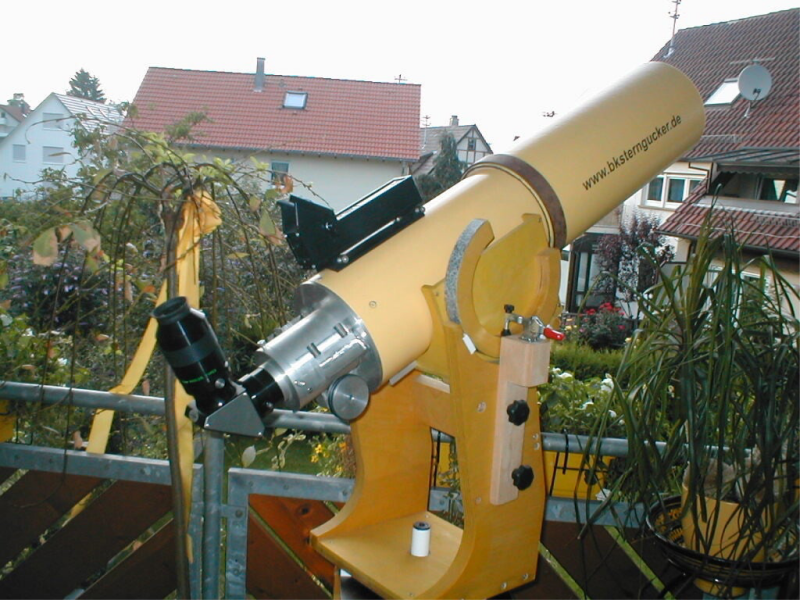
Jaegers Referaktor 152/762mm Kometensucher mit Kniehebel Höhenlagerbremse und UncAl's Handgranate, das 20mm Nagler Typ2 Okular.
Erstelle deine eigene Website mit Webador