The "Nachtgrabb" – a portable 16" Dobsonian since 2022
I felt I needed one more thing... something quick to set up and also mobile (pushable) enough to reach remote, dark locations that are inaccessible or off-limits to cars.
This led to the idea of building a second housing for my 16-inch mirror set—an alternative to the "Lemmon Butterfly" Telescope (air-travel Dobsonian) setup.
This time, the requirements differed somewhat from those for the 16-inch travel telescope designed for air travel.
It was acceptable for the scope to be sturdier—and slightly heavier—this time around.
It remains well-balanced for planetary observation, even when equipped with a binoviewer, a 60mm finder scope, and a Telrad.
Thanks to the large altitude bearing diameter of 80 cm, the Dobsonian stays balanced even without the load (a reduction of 4 pounds).
The Dobsonian is quickly set up using the Stropek/Klose clamping mechanism for the truss tubes on the primary mirror box.
The upper cage is attached to the pairs of poles using quick-release fasteners.
The mirror cells for the optics can be swapped between the telescope tubes quickly and with minimal effort. Again Yellow is my standard color choice.
The creation still needed a new name. "You're just a 'Nachtgrabb'!" was the reply I got when I spoke about my late-night activities at the telescope.
In southern Germany, the *Nachtgrabb* is a bogeyman figure that snatches children who are still outdoors after dark. It flies them so far away that they cannot find their way home.
There is a nearly extinct native bird from which the figure is said to originate: the northern bald ibis.
The "Nachtgrabb" gains true mobility thanks to its own wheeled base.
A bicycle trailer with quick-release wheels was first sawn apart and then widened using steel tubes slipped over the frame to fit the telescope.
A wooden chassis underneath stabilizes the trailer and protects my car's interior from the trailer's sharp edges.
The chassis also features a mounting socket for my modified astronomy chair, which doubles as a tow bar for the cart during transport.
The "tow bar" is strapped to the chassis.
The cart is assembled right next to the car and loaded with the Dobsonian telescope.
Within five minutes, the rig is ready to be pushed into areas inaccessible to cars.

The upper cage has taken shape, complete with spider, focuser, and finder brackets.

The interior of the mirror box, showing the mirror cell and the Stropek/Klose-style quick-release clamps.

To begin with, everything is pretty dusty.

Pre-formed rings for the Dobsonian's secondary housing

These small boards and two rings form the secondary housing for the 16" Dobsonian.

The tubes for the truss-style optical tube assembly are connected in pairs.

Clamping devices for the grid tubes are made from square tubing and window hooks.

altitude bearings assembled at the primary box

Balancing the center of gravity for the position of the elevation bearings.

First assembly of the new Dobsonian in my workshop.

The mirror cell viewed from the back

2 different tubes of the 16-inch mirror set.

Lateral guidance of the altitude bearings, based on the design by amateur astronomer Helmut Lang.

A view of the front, without the secondary mirror cell.

The trailer with a wooden chassis and quick-release skewers for the wheels.
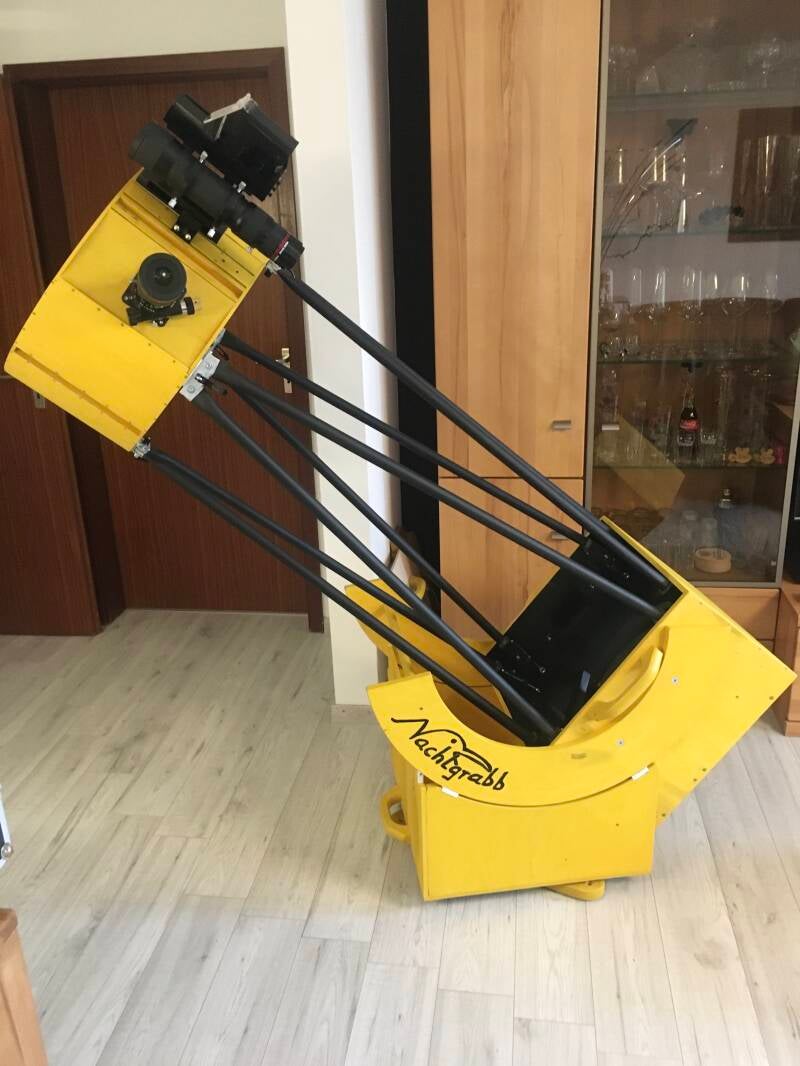
The " Nachtgrabb" is finished

The astro-chair functioning as a tow bar.


Erstelle deine eigene Website mit Webador